
Custom medal ribbon buyer guide
Choose the right medal ribbon width, material and print method.
A ribbon is part of the finished award—not an accessory to decide at the last minute. Its width, length, surface, artwork and attachment should be reviewed with the medal before sampling.

For many event medals, a ribbon around 20–25 mm wide is a practical starting point. Wider options such as 38 mm create more visual weight and print area for larger medals or sponsor artwork. Choose the final width together with total length, material, printing, medal weight, attachment and recipient requirements.
How wide should a custom medal ribbon be?
Ribbon width changes three things at once: how the medal hangs, how much branding can be printed and how the complete award looks in photographs. A narrow ribbon can suit a compact medal and a simple event name. A wider ribbon supports larger logos or sponsor layouts, but it can dominate a small medal.
| Ribbon width | Useful starting point | Buyer consideration |
|---|---|---|
| 15–20 mm | Compact medals, simple solid colors or short artwork | Limited print area; small lettering and logos need careful review. |
| 25 mm | General sports, school, race and recognition medals | A versatile proportion for clear event branding and common medal sizes. |
| 38 mm | Larger medals, premium awards or more involved branding | Provides more artwork space but adds visual bulk and packed volume. |
| Custom width | Special presentation, fashion or campaign requirements | Confirm availability, construction, cost and lead time before artwork approval. |
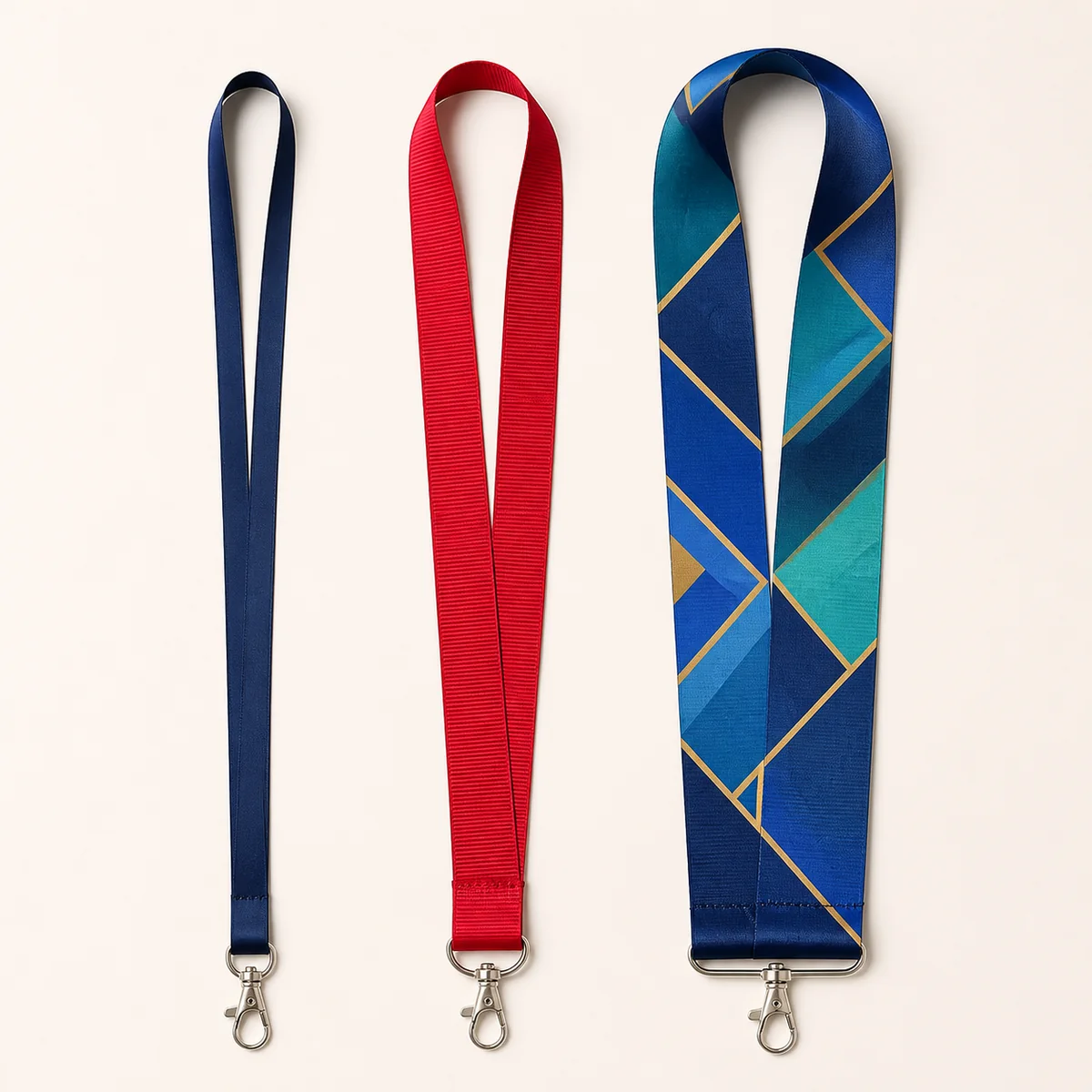
Place the ribbon beside a medal drawing at actual scale. A 25 mm ribbon can look balanced with one medal and too narrow or too wide with another because shape, diameter, thickness and weight also change the visual result.
For medal dimensions, see the custom medal size and thickness guide.
Confirm total length and recipient fit
Total ribbon length determines where the medal sits on the body. The correct specification depends on the recipients, the ceremony, clothing and event rules—not only on a generic adult sample.
- Adult events: confirm the target wearing position with a physical ribbon or measured reference.
- Schools and youth programs: review age range, desired length and applicable safety requirements.
- Presentation-only awards: a neck ribbon may not be required; a short drape, box or stand can be more suitable.
- International programs: record the finished total length and tolerance in millimeters to avoid assumptions.
If a breakaway or safety-release component is required, state it before quotation and sampling. It changes the ribbon construction and should be tested as part of the complete assembly.
Satin, grosgrain and printed polyester compared
“Polyester ribbon” does not describe one appearance. The weave and surface treatment determine gloss, texture, print behavior and how the ribbon feels in the hand.
Smooth satin-style ribbon
A clean, reflective surface for solid colors and polished presentation. Strong light can produce visible highlights in photographs.
Grosgrain-style ribbon
A ribbed texture with a more structured, less glossy appearance. Check how fine printing sits across the visible weave.
Sublimated polyester
Suitable for edge-to-edge color, gradients, detailed patterns and repeated event graphics on both ribbon legs.
Woven or specialty direction
Can create a textile-led look, but fine detail, reverse appearance, minimums and lead time should be confirmed by project.
Ask for a physical material reference when gloss or texture matters. Screen colors cannot fully show how a woven surface reflects light or how the ribbon drapes with the medal attached.
Choose printing around the artwork—not the process name
| Direction | Best suited to | Approval focus |
|---|---|---|
| Stock or custom solid color | Simple award systems, school colors and budget-controlled programs | Color reference, material sheen and batch consistency. |
| Simple repeated print | Event name, year, short URL or one-color sponsor marks | Legibility, repeat spacing, print alignment and seam position. |
| Dye sublimation | Gradients, multiple colors, detailed graphics and edge-to-edge patterns | Color proof, artwork scale, edge coverage and appearance after sewing. |
| Woven design | Textile texture and simplified repeat motifs | Minimum line size, reverse side, yarn colors and edge quality. |
A method that can reproduce many colors is not automatically the best choice. A one-color school ribbon may benefit more from clarity and repeatability than from a complex full-color print. Start with what recipients must recognize from normal viewing distance.
Prepare ribbon artwork at final size
Long ribbon artwork is different from medal-face artwork. It may repeat down both sides, cross a seam, reverse direction when worn or be partly hidden behind the recipient's neck.
- Set the actual width: create the artwork using the confirmed millimeter dimension.
- Protect edges: keep essential text and logos away from trim, fold and stitch areas.
- Plan the repeat: specify spacing and orientation so logos do not appear upside down on one side.
- Simplify small details: evaluate sponsor marks and thin lettering at physical size.
- Provide color references: identify required brand colors and understand that textile and metal surfaces reflect differently.
- Show the seam: approve where the ribbon ends meet and whether the join is visible from the front.
Use the custom medal design guide to coordinate ribbon artwork with medal relief, enamel and plating.
Match the attachment to medal weight and construction
The attachment is a working component. It controls medal orientation, assembly, movement and whether the ribbon can be removed or replaced.
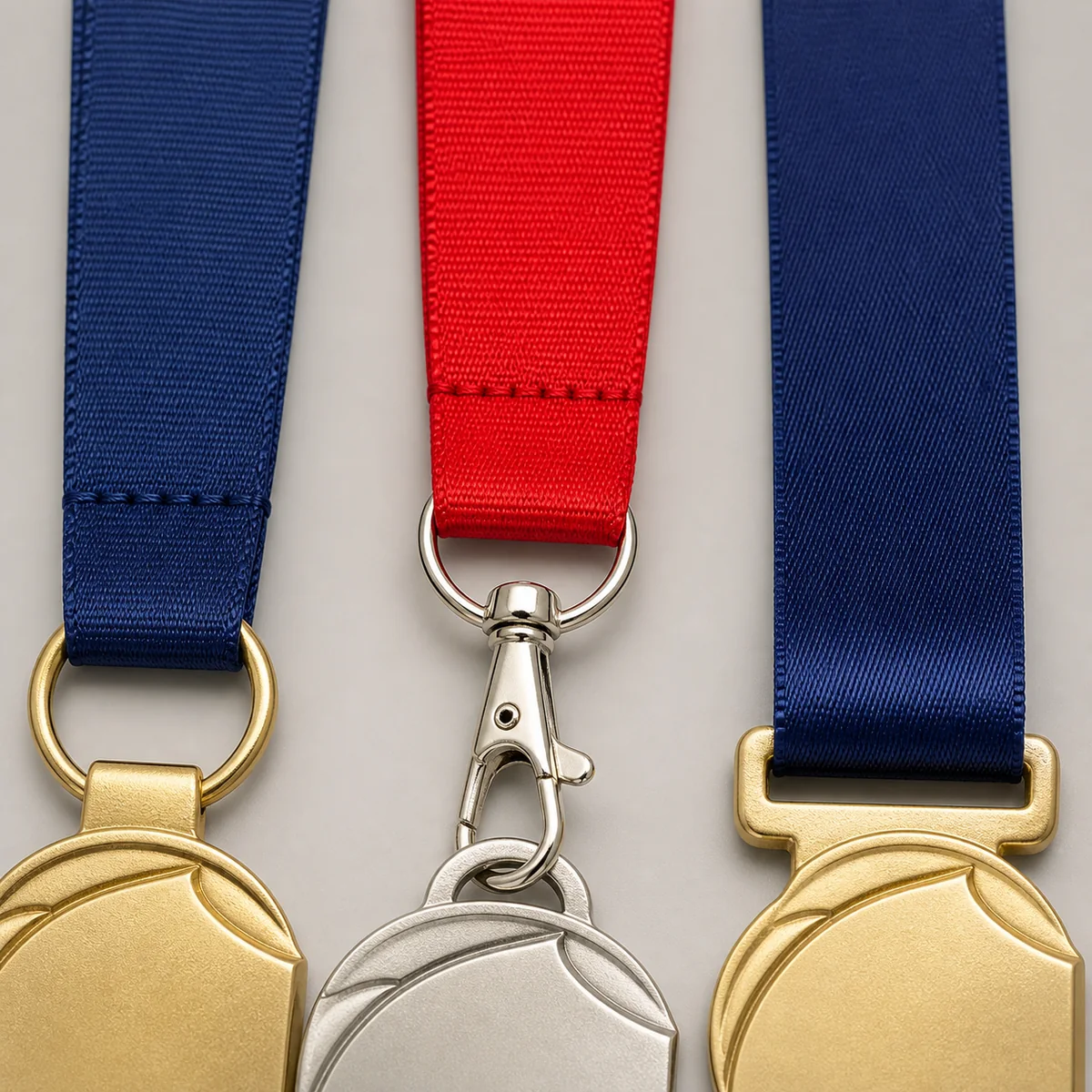
Sewn ring connection
A direct, compact assembly. Confirm ring diameter, seam position and whether the medal faces forward when worn.
Detachable hook
Useful when ribbons may be assembled, replaced or packed separately. The hook opening and load should suit the medal loop.
Wide slot
Integrates the ribbon visually with the medal and distributes the connection across a broader area. Slot width must match the ribbon.
Safety component
Selected youth, workplace or public events may require a release. Confirm applicable standards with the organizer.
Choose by event and distribution plan
| Program | Practical ribbon direction | Question to settle |
|---|---|---|
| Race or sports event | Visible event branding, comfortable drape and secure assembly | Will sponsor artwork remain readable in finish-line photographs? |
| School awards | Clear school colors, age-appropriate length and simple award-level coding | Are there youth safety or ceremony requirements? |
| Corporate recognition | Controlled brand colors and a refined surface | Will the medal be worn, boxed or displayed? |
| Multi-event series | One base construction with controlled color or artwork variants | Which elements must stay consistent across every event? |
For project examples, compare custom race medals, school medals and employee recognition medals.
Ribbon approval checklist
- Dimensions: width, finished total length and agreed tolerance.
- Material: weave, surface, thickness, drape and color.
- Artwork: final-size logo, text, repeat, orientation and edge allowance.
- Construction: seam location, stitching color, ring, hook, slot or safety release.
- Assembly: medal faces forward and hangs without excessive twisting.
- Packing: ribbon folding method does not scratch the medal or create unwanted creases.
- Variants: quantities for each award level, color, sponsor or event date.
A separate medal sample and ribbon swatch do not show every assembly issue. When possible, approve the medal, ribbon, attachment and packing together before mass production.
Add these details to the custom medal order checklist before requesting a quotation.
Frequently asked questions
What is a common width for a custom medal ribbon?
Widths around 20–25 mm are common for general event medals. Wider options such as 38 mm provide more print area and can balance a larger medal. Confirm the final width with the medal dimensions and artwork.
Can a ribbon include full-color artwork and gradients?
Yes. Dye sublimation is commonly considered for detailed, edge-to-edge and multicolor artwork. Review all details at final size before approval.
Should children use the same ribbon length as adults?
Not automatically. Confirm recipient age, desired wearing position, event rules and any safety-release requirements before production.
Which attachment is best for a heavy medal?
Review medal weight, ribbon width, ring or slot geometry and intended use together. The complete assembled sample should hang securely and face correctly.
Can the same ribbon be used for gold, silver and bronze awards?
Yes. One ribbon can unify the program, or ribbon colors and printed award levels can distinguish categories. Record the quantity for every variant clearly.
What should be approved on the sample?
Approve width, total length, material, color, print position, artwork scale, seam, attachment, medal orientation and packing.