
Custom medal specification guide
How to choose custom medal size and thickness.
Compare 50mm, 60mm, 70mm and 80mm medal formats, then balance artwork space, weight, ribbon proportion, packaging and cost before approving production.

There is no single standard custom medal size. For many event and recognition projects, 60–70mm is a useful starting range: it gives logos and text practical space without automatically creating an oversized piece. Simpler designs may work at 50mm, while 80mm and larger formats suit designs that need stronger visual impact. Thickness is commonly discussed around 2.5–4mm, but diameter, material, relief, cut-outs, target weight and budget must be reviewed together.
How custom medal size is measured
Round medals are normally described by diameter. Square and rectangular medals use width and height. For an irregular outline, the longest dimension of the medal body is usually the most useful starting measurement.
The quotation and production proof should also show whether the ribbon loop or bail is included in the stated height. Two suppliers can describe the same piece differently if one measures only the medal body and another includes the attachment point. Confirm the measurement method on the approved drawing instead of relying on a product name such as “medium” or “large.”
For a quick conversion, 10mm equals 1cm: 50mm = 5cm, 60mm = 6cm, 70mm = 7cm and 80mm = 8cm. Inches are also useful for buyers, but keep the approved production dimensions in millimeters to avoid conversion and rounding errors. For reference: 50mm is about 1.97 inches, 60mm is 2.36 inches, 70mm is 2.76 inches and 80mm is 3.15 inches.
50mm, 60mm, 70mm and 80mm medals compared
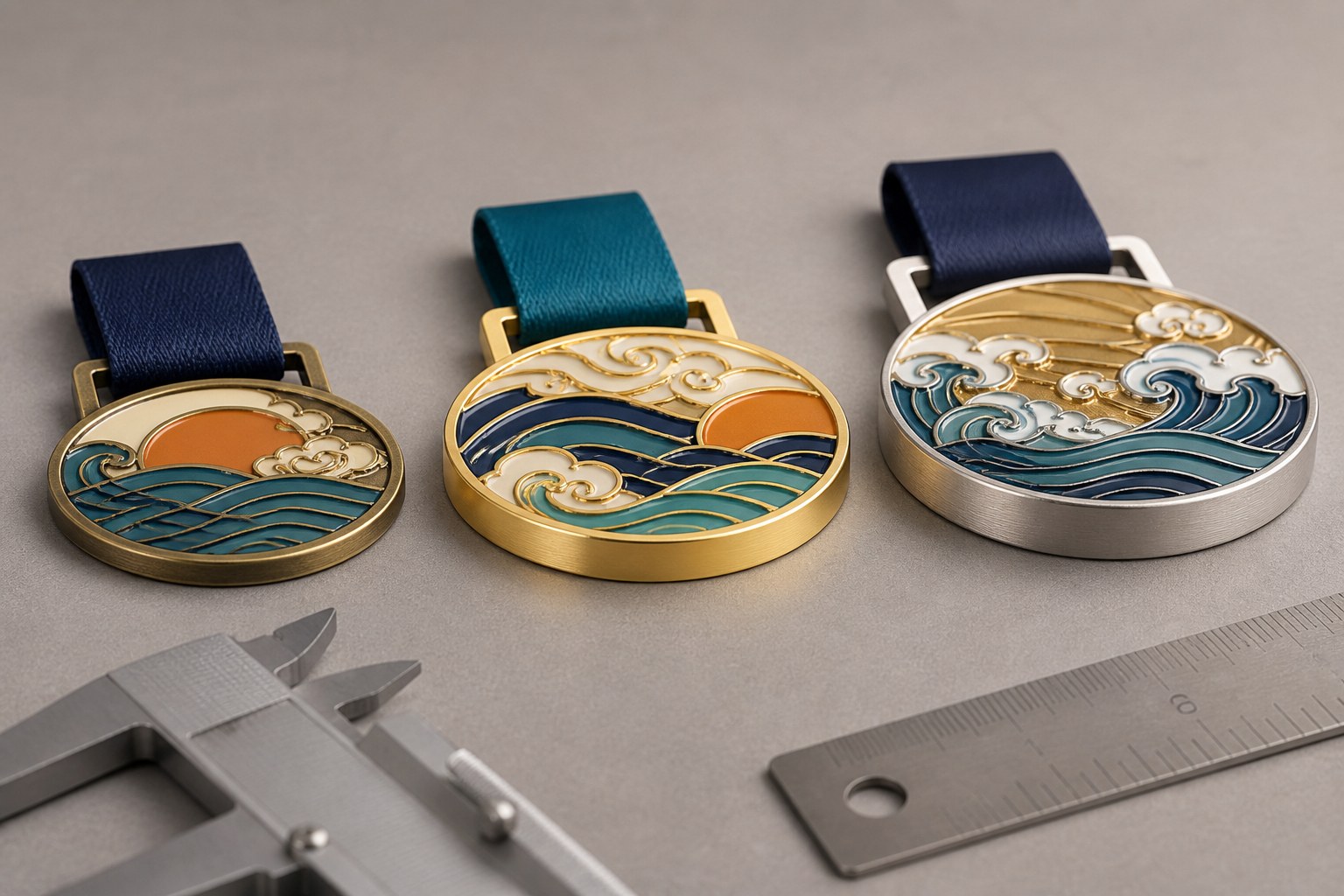
The hero comparison above is an illustrative planning reference, not a fixed industry rule. A design with large shapes and little text can work at a smaller diameter, while a detailed crest, sponsor list or layered scene may need more room.
Swipe across the table to compare all columns →
| Medal size | Centimeters | Approx. inches | Useful starting point for | Planning considerations |
|---|---|---|---|---|
| 50mm | 5 cm | 1.97 in | Simple participation awards, compact recognition pieces and designs with one clear symbol | Keep text short and avoid crowded fine detail |
| 60mm | 6 cm | 2.36 in | School events, club awards, corporate recognition and straightforward race medals | Balances wearable size with useful artwork space |
| 70mm | 7 cm | 2.76 in | Finisher medals, tournaments and designs with event names, dates or multiple visual elements | Provides more room for readable text and stronger presentation |
| 80mm | 8 cm | 3.15 in | Championships, premium events and statement medals intended to stand out in photographs | Review weight, ribbon width, packing and freight before approval |
| 90mm+ | 9+ cm | 3.54 in+ | Oversized ceremonial, collector or signature-event pieces | Material, comfort, support points and packaging become more important |
The best size is the smallest dimension that preserves the intended identity and readability while meeting the desired presentation. Making every design larger does not automatically make it better.
Choose size around the event and recipient
Race and finisher medals
Finisher medals often need to be visible in event photography and may carry the race name, distance, year and sponsor elements. A larger diameter can help, but the piece still needs to hang comfortably. Cut-outs can reduce weight while creating a distinctive silhouette.
School and youth sports
Comfort, budget and safe distribution may matter more than maximum weight. A clear 50–60mm design with a simple logo and short text can look more professional than a larger medal filled with details that cannot be read.
Club tournaments and corporate awards
A 60–70mm starting point often provides enough space for a crest, event title and date. If recipient names or individual results are required, decide whether they will be engraved, printed, placed on the reverse or added to the packaging.
Championship and presentation medals
An 80mm or larger format can create stronger visual presence, especially with deeper relief or a presentation box. Confirm how the medal will be worn, displayed and shipped before treating size as the only measure of quality.
How thick should a custom medal be?
Thickness changes perceived weight, edge appearance, relief capacity and cost. Many custom medal discussions begin around 2.5–4mm, but this range is not a universal standard. The final choice depends on the construction and artwork.
| Thickness direction | Possible benefit | What to check |
|---|---|---|
| About 2.5–3mm | Lighter feel and lower material use for simpler designs | Relief depth, rigidity and edge appearance |
| About 3–3.5mm | Balanced starting range for many general medal programs | Diameter, alloy, ribbon and total target weight |
| About 4mm or more | Heavier presentation and more edge presence | Neck comfort, support around cut-outs, packing and freight |
A thicker medal is not always more premium. If the artwork is flat and simple, extra thickness may add weight without improving the visible design. A well-controlled relief, clean finish and appropriate ribbon can create greater perceived quality than thickness alone.
Size must be reviewed with the artwork
A design viewed on a large monitor can appear clear even when its smallest text and lines will not reproduce well at actual medal size. Review the production proof at 100% scale before approving tooling.
- Keep the main symbol recognizable at the final diameter
- Reduce unnecessary wording before shrinking the font
- Leave enough metal between enamel areas, cut-outs and the outer edge
- Separate solid enamel colors with manufacturable metal lines
- Check whether small gradients or photographs require printing instead of enamel
- Plan the front and back together rather than adding the reverse at the end
- Confirm that the ribbon loop has enough support for the medal weight
For a complete artwork brief, use the custom medal design guide before sending files for review.
Match the ribbon and packaging to the medal
A medal and ribbon should look like one product. Compact medals can work with a narrower ribbon, while larger or heavier medals may need a wider ribbon for visual balance and wearing comfort. Common project discussions include ribbon widths around 25mm, 30mm and 38mm, but the right choice depends on the design, printed content and event use.
Packaging should be planned at the same time. Individual bags are efficient for mass distribution. Backing cards, velvet pouches and presentation boxes require more space and can change carton dimensions and freight. If medals will be inserted into participant packs, confirm the final packed dimensions before production.
Ask to see the medal dimensions, loop, ribbon width and packaging direction on the same controlled specification. This catches proportion and packing problems before mass production.
Why diameter does not tell you the final weight
Two medals with the same outside dimensions can have different weights. Material, thickness, relief, recessed areas, open cut-outs and the size of the ribbon loop all change the amount of metal. Plating and enamel affect appearance, while the body construction has the larger influence on weight.
If weight matters, give the factory a target direction such as lightweight for youth participants, balanced for a long race, or substantial for a presentation award. The physical sample is the best point to confirm how the finished medal feels.
Diameter and thickness also affect cost. Larger or thicker medals normally use more metal and create more shipping weight. See the custom medal cost guide for the other quotation factors.
Six common size-planning mistakes
| Mistake | Possible result | Better approach |
|---|---|---|
| Choosing size before simplifying artwork | A larger medal is used to preserve unnecessary detail | Prioritize the main identity first |
| Approving only a zoomed digital proof | Text looks clear on screen but small in hand | Review the proof at actual size |
| Increasing diameter and thickness together | Unexpected weight and freight cost | Decide which dimension creates the required impact |
| Ignoring the ribbon proportion | The medal looks visually unbalanced | Approve medal and ribbon as one assembly |
| Forgetting the reverse design | Back text or logos become crowded | Plan both sides before tooling |
| Using “standard size” without a number | Buyer and supplier expect different dimensions | State millimeters on the quote and proof |
What to send for a size recommendation
The factory can make a more useful recommendation when size is considered with the complete project rather than as an isolated number.
- Front and back artwork, sketch or reference image
- Event type and how the medal will be presented
- Estimated quantity per design
- Preferred diameter or an acceptable size range
- Desired weight direction: light, balanced or substantial
- 2D, 3D, enamel, print or mixed construction
- Ribbon width, color and printing requirements
- Packaging direction
- Destination country and required arrival date
If several details are still undecided, start with the custom medal order checklist. A typical Extra Dream sample takes 7–10 days after artwork and specifications are confirmed; the full schedule is explained in our custom medal production-time guide.
Custom medal size FAQ
Questions buyers ask before artwork approval.
What is a standard custom medal size?
There is no single standard. Many projects begin in the 50–80mm range, with the final size selected around artwork, event use, weight, ribbon and budget.
What size is practical for most events?
A diameter around 60–70mm is a useful starting point for many school, club, race and corporate programs. The final decision should follow an artwork and presentation review.
How thick should a custom medal be?
Many projects are discussed around 2.5–4mm. Diameter, material, relief, cut-outs, desired weight and cost determine the appropriate thickness.
How is an irregular medal measured?
It is normally planned using the longest dimension of the medal body. Confirm whether the loop or bail is included on the approved production drawing.
Is a thicker medal always better?
No. Extra thickness can add weight and cost without improving a simple design. Proportion, relief, finishing and ribbon choice should be considered together.
Should I choose size before sending artwork?
You can provide a preferred range, but the final size should be reviewed with the artwork. Fine text, relief, cut-outs and enamel divisions may require adjustment.