
Military & First Responder Challenge Coins: Edge Cuts, Serial Numbers, and Deep 3D Traditions
A coin may fit in a palm, but its design has several jobs: identify the group, explain the occasion and give the recipient something worth keeping.
Start with the presentation, not the plating
Imagine a station presenting a retirement coin after a colleague’s final shift. The helmet may identify the profession, but the name, dates and shared message make the piece personal. Extra decoration cannot replace those decisions.
Military coin stories are rich in tradition, although their origin is not one settled account. The US Department of Defense’s history feature discusses competing explanations. Treat a colorful origin story as a story, not a specification every organization must follow.
For your order, define who receives the coin and why. A unit presentation, recruit graduation, retirement and commemorative fundraiser can require different wording, quantities and packaging.
Give the two faces different jobs
The front can establish identity through one dominant emblem. The reverse can explain the occasion, carry a motto or reserve space for a recipient’s details. Trying to place every message on both sides usually makes the hierarchy harder to read.
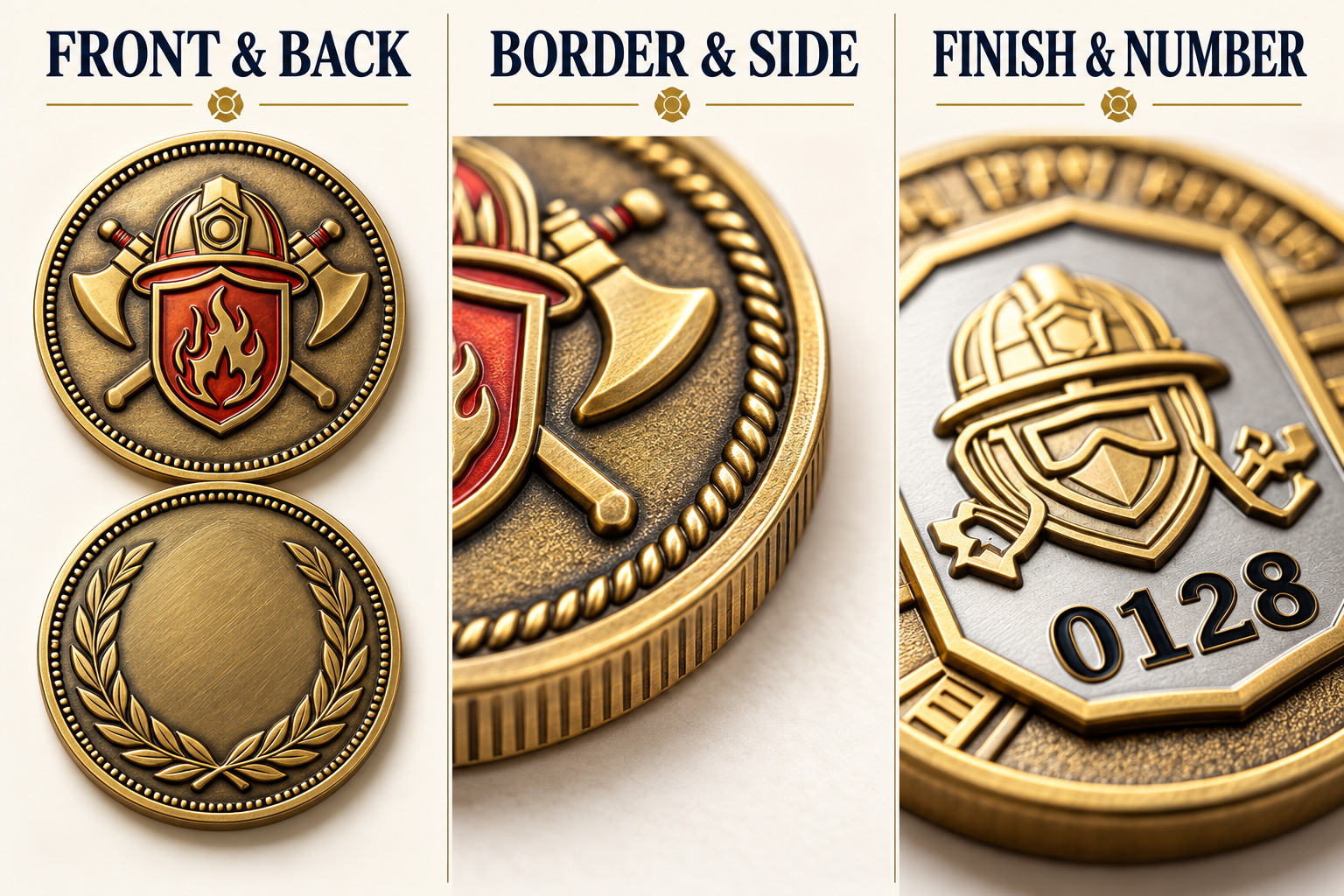
In the firefighter concept above, the helmet and tools provide a recognizable center. The blank reverse is an opportunity to decide what matters, rather than fill space with another unrelated motif.
Have the organization confirm its artwork and exact wording before production. Ask one person to consolidate spelling, dates, names and emblem revisions. Keep the approved front and back together in the same proof, with their relative orientation identified.
Two surfaces, two decisions
A rope border is not the side edge.
Face border: the decorative ring seen around the front or reverse.
Side edge: the narrow surface around the coin’s thickness.
Request both a face view and a side view. A supplier’s style name alone may not describe the complete construction.
Choose edges with a reference you can point to
A rope-like pattern can frame an emblem on the face, while the side remains plain or grooved. Conversely, a decorative edge treatment may change the outer profile without adding a rope motif to the face.
If you want a diamond-cut appearance, send a close-up of the intended result and ask how it will be produced. Do not assume every faceted-looking render represents the same machining operation. Confirm which surface is treated and whether both sides receive the treatment.
Review the physical edge for the intended use: a presentation case, pocket carry or display stand. Ask about handling comfort and packaging protection alongside appearance. The edge should support the coin’s purpose.
Numbering needs rules before it needs a font
The sample number “0128” looks simple. A production list raises more questions: does the range begin at 0001, are leading zeros required, and should a replacement repeat the original number or receive a new one?
Agree on position, character size, number range and marking method. A number shown in a rendering does not establish that it will be laser marked. The supplier must confirm the proposed method and resulting appearance.
For an individually numbered edition, request a checking and packing plan that keeps numbers traceable. Clarify duplicates, rejected pieces and replacements before dispatch. Numbering can distinguish pieces, but it does not independently prove authenticity or edition control.
250 unique numbers
- Confirm the exact range and format.
- Mark the location on the proof.
- Agree how missing or duplicate numbers are handled.
- Identify cartons or packs if sequence matters.
Use two finishes to establish emphasis
A gold-tone emblem against a silver-tone field can make the main subject easier to distinguish. Before ordering a two-tone effect, identify the boundaries on the artwork rather than relying on a general instruction such as “make the badge gold.”
Ask the supplier to confirm whether the proposed effect uses selective plating, separate components or another construction. A photograph cannot reliably answer that question. Review the sample around small corners and boundaries, where the intended separation needs to remain clear.
Keep finish approval separate from color approval. Antique shading, polished highlights and filled colors contribute different things to the final appearance. Our metal finish guide provides a starting point for the discussion.
Deep relief works best with breathing room
A helmet can benefit from sculpted curves, but placing tiny lettering immediately beside a high feature may make the composition crowded. Give the main form space and let quieter background areas support it.
Specify what should be prominent, then review front and angled model views. “Deep 3D” is not a complete dimensional instruction. The supplier must assess thickness, transitions and feasibility for the selected process.
Do not judge depth only by dramatic lighting in a render. Ask how the approved geometry will be checked, and discuss a physical sample when shape or handling matters. See our artwork-to-relief guide for the handoff between illustration and model.
Build a brief around the recipient
A useful inquiry might say: “We need 250 retirement presentation coins with our approved emblem, a plain side edge, a rope-style face border and individual numbers. Please quote the proposed two-tone finish and sample review separately.”
Attach the front and reverse artwork, dimensions, wording, numbering list and required receipt date. Explain how the coins will be presented. That gives the factory something more useful than a list of premium-sounding effects: a clear object with a clear purpose.
Plan a coin that carries your message
Send Extra Dream your approved artwork, quantity and presentation requirements. We can discuss edge references, numbering and relief before production.
Discuss your challenge coin ↗