
Souvenir retail · Card bottle openers
Custom Credit Card Bottle Openers for Souvenir Shops: Design & Packaging
Develop a recognizable landmark, a working opener and a retail pack that holds the finished product neatly.
Souvenir shop buyers often want three things from a card bottle opener: a landmark visitors recognize, a compact keepsake they can take home, and an opener they can actually use.
Planning a custom credit card bottle opener means developing those requirements together. A landscape photograph may need reworking at the finished size. A thin outline still needs support where it opens the bottle. Add a backing card and clear bag, and the complete assembly also has to hang neatly and release the product for use.
This guide follows a project for a souvenir retailer in New Zealand's lake district. The customer and testimonial author remain anonymous.
Choose the landmark visitors should recognize before adapting the photograph.
The retailer wanted a card-format opener featuring the Wānaka Tree, also known as That Wānaka Tree, for visitors to the lake district. The initial brief called for a landscape photograph printed across the front of a rounded card, with the opening feature on the reverse.
Artwork review and sampling showed a problem with this particular photograph at the reduced size. The tree, water, distant mountains and small background details competed within a limited area. Distant details were unclear on the metal, making the subject difficult to recognize from a retail display.
We proposed retaining the main tree, shoreline and lake outlines, rebuilding the image with metal line relief and selected paint-filled areas, and simplifying the background. The aim was a clear visual order at the actual product size.
Photographs do not always need to become line art. Decide whether to retain a photograph by reviewing the source quality, subject size, printing method and physical sample. At a realistic viewing distance, what do visitors notice first? Can they still distinguish the landmark and place name from the background?
If one theme will also appear on pins, magnets or other formats, plan the composition for each product separately. Our cultural merchandise development guide covers the wider process.
Allow space for the opener mouth, grip and reinforcement.
A credit-card-sized outline and credit-card thickness are separate requirements. For a useful comparison, card manufacturer CardPrinting lists a common CR80 plastic card at approximately 85.60 × 53.98 mm, with a thickness of 0.76 mm—roughly 0.8 mm. These are plastic-card reference dimensions, not the finished specifications of this opener project.
A metal opener also needs room for bottle-cap contact, structural support and the user's fingers. Relief, reverse-side reinforcing ribs and an epoxy coating all occupy space. Check the finished thickness at its highest projection rather than measuring only the flat base.
If the buyer requires a snug leather-wallet card slot, specify the slot opening, internal dimensions, maximum thickness and insertion/removal clearance before sampling. Test the complete sample in that slot. For a thinner direction, ask the factory to assess a stamped metal-sheet design. If the design retains raised relief, reinforcing ribs and epoxy, allow space for those features. Evaluate opening performance and storage fit for each direction.
This project's original design used thin cold-rolled steel sheet. Artwork review and sample use raised concerns about bending during repeated opening and the condition of the opening edge. The revised direction used zinc alloy together with a modest thickness increase and reinforcement around the opening feature.
| Issue in this project | Agreed adjustment | What to check on the sample |
|---|---|---|
| The reduced photograph lacked a clear subject | Metal line relief and selected paint-filled areas, retaining the tree and lake outlines. | Whether visitors can recognize the landmark at the finished size. |
| The thin sheet could bend during opening; the opening edge needed improvement | A zinc-alloy design with thickness and reinforcing-rib adjustments. | Reliable cap engagement, a stable grip, and any deformation after opening. |
| The artwork surface was exposed to handling friction | A clear epoxy coating over the painted design. | Gloss, image clarity and the surface after practical handling. |
| The product tilted or lifted on its retail card | A raised hang-hole position, 300 g/m² white card and die-cut retaining features. | A secure, upright presentation after bagging and hanging. |
The improvement came from the combination of material, thickness and structure. It does not establish that zinc alloy is always stronger than steel. The North American Die Casting Association's NADCA reinforcing-rib guidance describes the support and stiffness ribs can provide, while explaining that their need and layout depend on the part design.
For purchasing, the useful check is a physical sample. Open the intended bottle cap, assess contact and grip, and inspect for deformation. Review the reverse ribs, text and packaging fit together. A front-view artwork rendering cannot confirm opening performance.
Project sample photograph
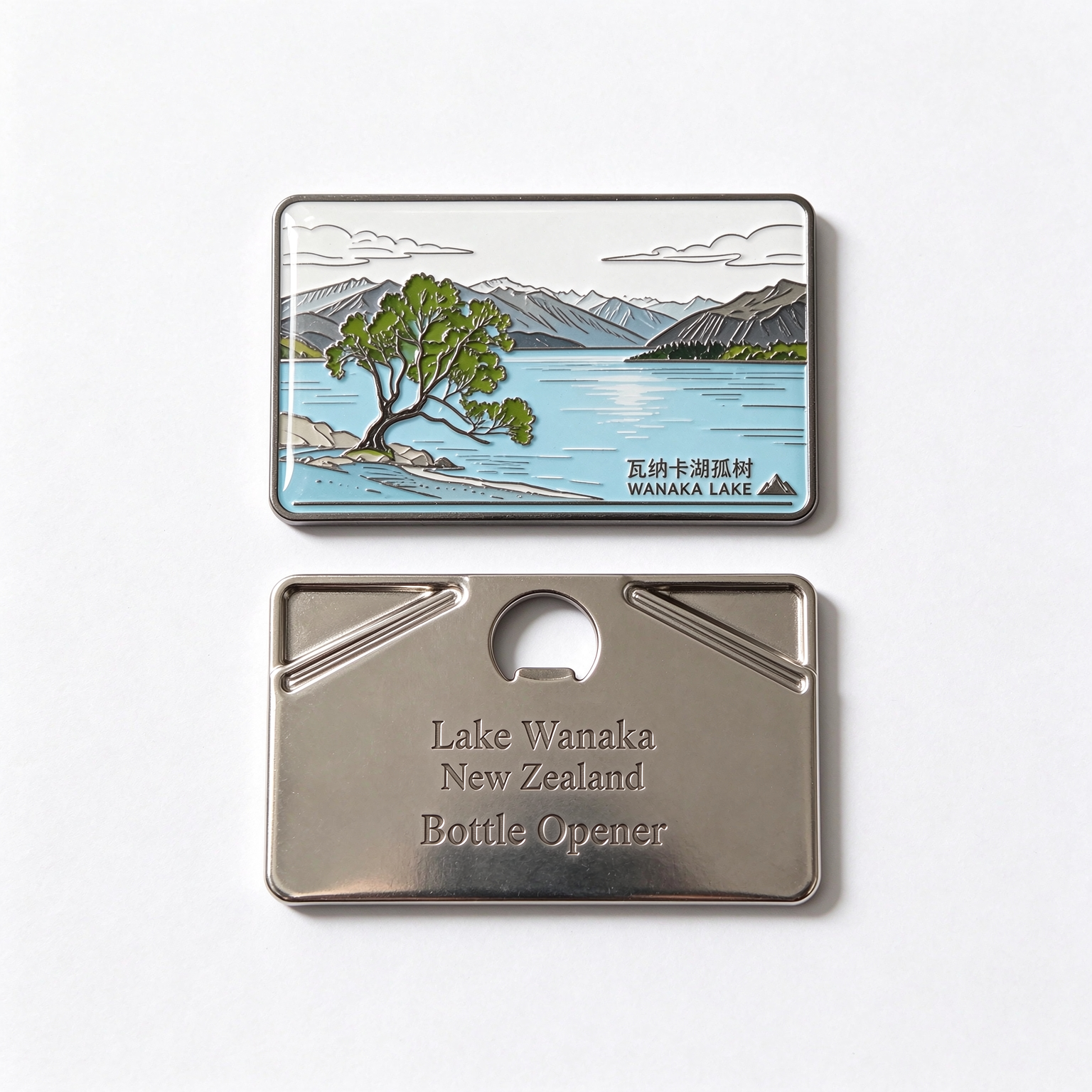
Check epoxy gloss, thickness and contact with the cap and packaging.
For this order, the painted front received a clear epoxy coating and the reverse was polished. The customer wanted to protect the artwork while retaining the lake design's clear, bright colours.
Epoxy changes gloss and feel and adds local thickness. Alongside a front-view photograph, review the sample under retail lighting: do reflections obscure the subject? Check the coating boundary, metal frame and contact after bagging.
This project's opening feature is on the reverse. For this type of design, also follow the opening action to identify where the cap's rolled edge or teeth make contact. Keep the epoxy coverage clear of the mouth edges that directly engage the cap and carry opening friction. The metal contact surface, without epoxy over it, should perform the opening action. An area without epoxy may still have plating or another metal surface treatment.
Check for white marks, scratches or a lifted coating edge after opening. If the coating enters the cap's contact path, adjust its boundary or the mouth geometry before confirming the function. This is a structural and surface-interface check; front-and-reverse photographs alone cannot establish it.
After delivery, the customer reported that the artwork did not scratch easily. That describes their experience; it does not make clear epoxy permanently scratch-proof. For products that will be displayed and handled repeatedly, approve a fully bagged sample and check whether the bag or adjacent products can rub against the front.
Specify the metal finish, colour fill and protective coating separately. Our metal finish and process guide provides an overview of appearance options before physical sample approval.
Design the hang hole, retaining features and bag as one retail assembly.
The customer's first packaging direction used a 250 g/m² white backing card and an OPP bag. The original mounting position was close to the opener cutout. Movement during hanging could lift the thin piece and leave the front sitting at an angle.
We moved the backing card's hang hole upward, changed to 300 g/m² white card and added die-cut retaining features around the product. Separate the two jobs: the upper hole hangs the card on the rack; the retaining features hold the product. The opener cutout should not simply become the only mounting point.
Review the backing card alongside the reverse opening feature, ribs and text. A higher paper grammage was one part of this project's adjustment. Stability also depends on the retaining dimensions, supported area and assembly method.
The agreed single-item pack combined a retaining backing card and a resealable clear OPP bag. Check the complete sample for:
- Hanging presentation: an upright front and a hang hole compatible with the shop's hooks.
- Product retention: no sliding or lifting during handling, with retaining features clear of unsuitable contact points.
- Artwork visibility: the card, bag opening and price label do not cover the tree, place name or main image.
- Practical use: the visitor can remove the packaging, grip the opener, open a bottle and store it again.
Retail display reference
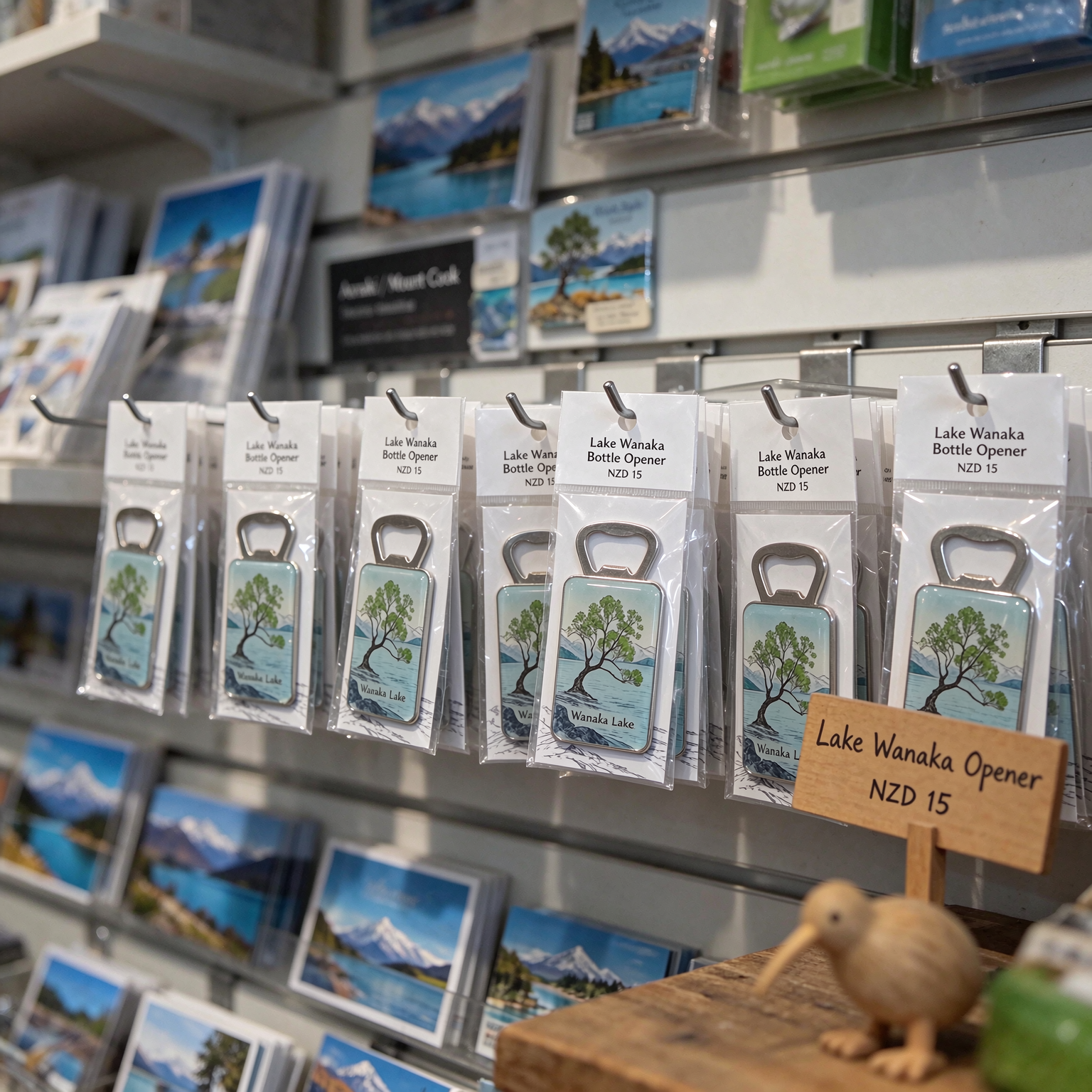
Fitting inside an envelope does not establish the postal service.
The customer wanted visitors to be able to place the souvenir in an envelope with a postcard, and later reported purchases intended for posting as gifts. That explains the carrying and gifting scenario; it does not establish eligibility for ordinary letter postage.
For example, NZ Post's international Economy Letters guidance restricts the contents to paper-based letters and similar documents. A metal opener does not become a paper letter because it fits inside an envelope. Confirm a service that accepts the item, using the packed dimensions, weight, contents and destination.
If convenient posting is part of the retail brief, identify the intended envelope or mailing packaging before development. Then check the metal item's full thickness, ribs and epoxy projections, and allow for protection in transit.
What the customer approved, and what they reported after delivery.
The customer reviewed the line artwork, epoxy gloss and opening force on the sample, then placed the bulk order. After delivery, they reported a suitable weight and feel, a recognizable landmark, neat hanging presentation and good sales during the tourist season.
For another project, make one complete sample-approval list: artwork and place name, finished dimensions and weight, opening function, edge feel, surface protection, card retention and single-item packaging. Reserve space for any barcode, price label or product code before sampling.
For later landmark designs in the same collection, state the quantity for each version separately. Matching outer dimensions do not automatically mean every tool can be shared. Changes to metal relief or reverse lettering need their own tooling assessment.
Copy a souvenir card bottle opener inquiry brief.
Project and sales setting: [Souvenir shop / attraction shop / hotel retail; intended visitors]
Landmark and artwork: [Photograph, illustration or logo files and permission to use them; essential subject, place names and languages]
Dimensions and storage: [Target length, width, thickness and weight; for wallet use, slot opening, internal dimensions and maximum thickness; for envelope packing, packaging dimensions]
Opening and surface requirements: [Opening position, grip and material preference; printing or metal line relief with colour fill; epoxy requirement and coverage boundary]
Display and packaging: [Peg hooks or flat display; card retention, barcode and price-label positions, individual bagging]
Versions and quantities: [Quantity for each landmark or colour version; expected reorders or collection extensions]
Destination and timing: [Receiving country and postcode; target peak-season shelf date and latest acceptable receipt date]
You can select and copy the brief above.
Please assess landmark recognition, support around the opener mouth, total finished thickness and the complete packaged sample. Separate the quotation scope for tooling, samples, packaging and bulk production.
Discuss your souvenir project with Extra Dream.
Extra Dream is the export brand of Wenzhou Oasis Metal Products Factory. Share the landmark artwork, retail setting, quantities by design and packaging requirements so we can discuss artwork adaptation, opening structure and complete-sample approval.
Explore our custom metal bottle openers or learn about our factory and customization capabilities.
Discuss your custom projectQuestions before ordering.
Can a landmark photograph be printed directly on a card bottle opener?
A printed design can be assessed; photographs do not always need to become line art. In this project, the reduced photograph had too much background detail, so metal lines and selected colour fill emphasized the tree and lake. Decide using source quality, finished size, printing method and the actual sample.
Does a card bottle opener have to be as thin as a bank card?
No. Card format describes the outline. The opening feature, reinforcing ribs, relief and surface protection can all affect total thickness. Provide the wallet slot opening, internal dimensions and maximum thickness, check the sample's highest projection, and test insertion and removal. Stamped-sheet and raised die-cast designs can be assessed separately; the name alone does not confirm a fit.
Will changing from thin steel sheet to zinc alloy prevent bending?
The material name alone cannot guarantee that result. This project changed material, thickness and rib structure together, then confirmed opening performance on the sample. Another project needs assessment of its specific material, geometry and intended use.
Are a 300 g/m² backing card and an OPP bag enough to confirm final retail packaging?
Those were this project's agreed components, not a universal specification. Check retention, hang-hole position, reverse projections, contact inside the bag and compatibility with the shop's hooks. If posting is intended, separately confirm protective packaging and an appropriate postal service.