
Hotel & restaurant teams · Metal name badges
Custom Uniform Name Badges: Logos, Finishes & Backings
Choose a clear layout, an appropriate finish and a backing that works with the actual uniform.
Custom metal name badges need to identify the hotel, make the employee’s name and role easy to read, and work with the uniform they actually wear. An attractive flat layout does not confirm how a badge will sit on a shirt. A polished surface on a desk does not show how it will look after repeated handling and wiping.
When buying hotel staff name tags, review the artwork, finish, backing and clothing as one arrangement. A boutique coastal hotel in Singapore changed all four during one project.
1. Decide whether the team needs a shared logo pin or a personal name badge
A shared logo pin can establish a consistent brand identity. If guests also need to identify the employee, allow for a name and job title. These choices involve different versions, text checks and reorder arrangements.
| The buyer’s task | Direction to consider | Confirm before ordering |
|---|---|---|
| Keep the brand identity consistent | A fixed-logo metal pin | Whether a separate name badge is needed, and where each item will be worn. |
| Show the brand, employee and role together | A personalized metal name badge | Every person’s wording, longer-name layouts and reorders after a role changes. |
| Accommodate frequent staff changes | Assess changeable-name construction, or pair a shared logo pin with a separate name badge | How information changes, the finished appearance and whether the supplier supports the required construction. |
A reusable name badge and a metal badge with permanently applied text need separate construction and quotation checks. “Staff badge” does not identify one standard product.
Logo shapes and lettering references
These reference images illustrate logo outlines and lettering layouts. They are not photographs of the Singapore hotel order. A front view does not establish material, dimensions, production stage or a backing suitable for uniforms.
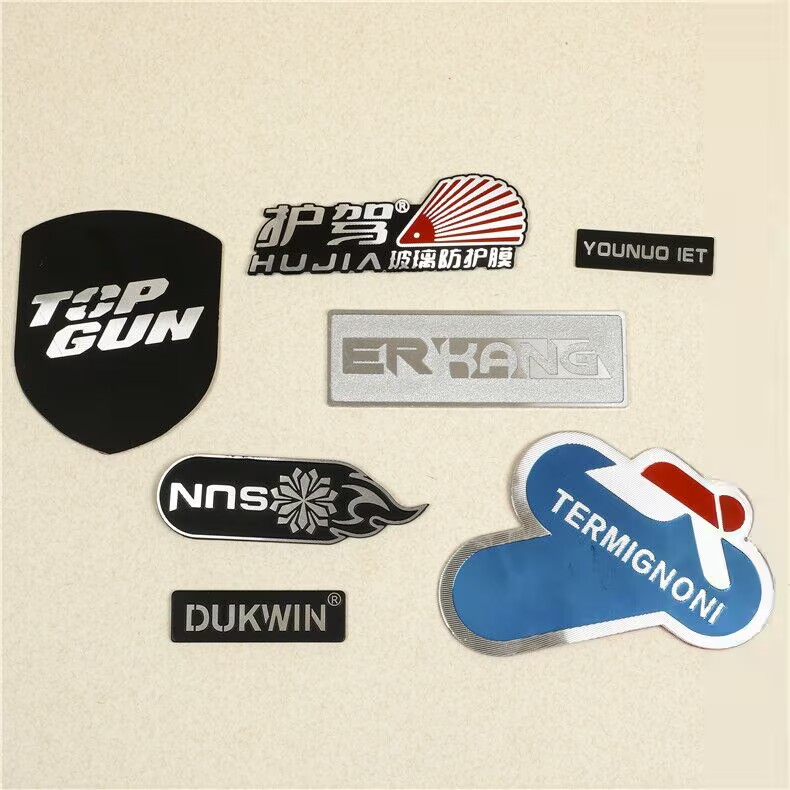
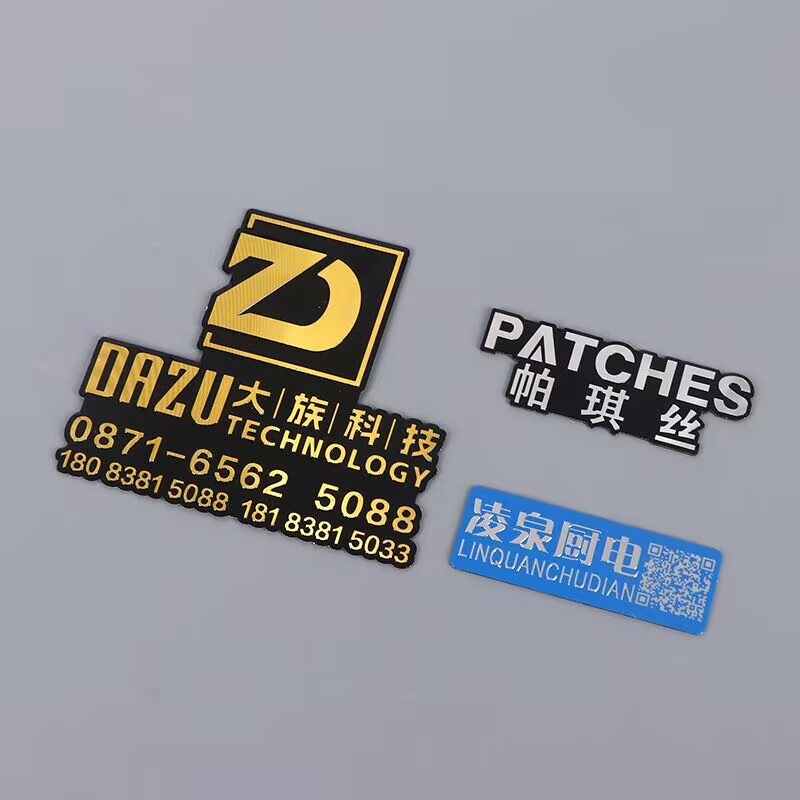
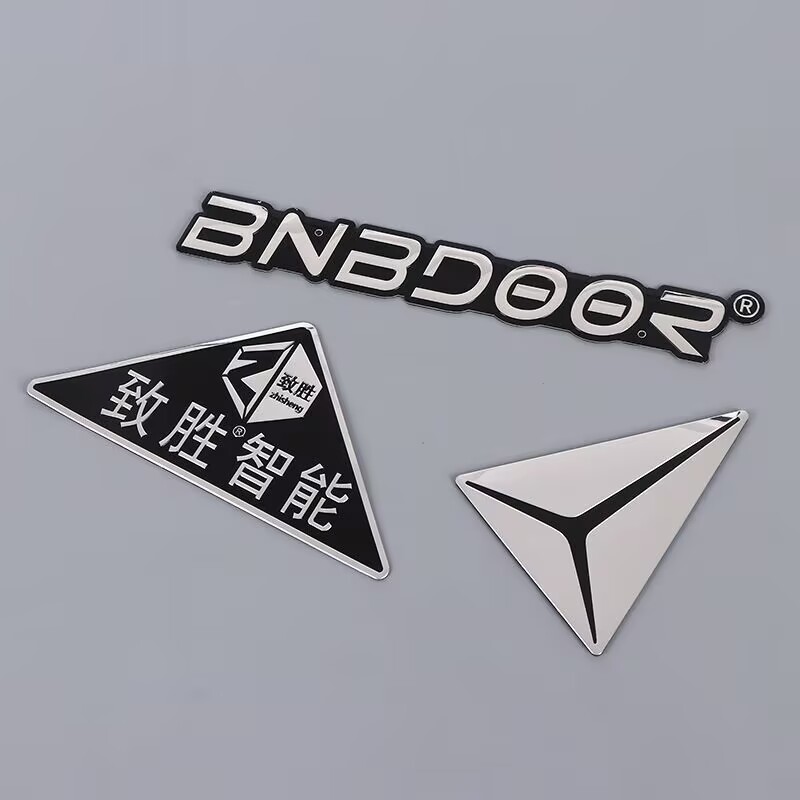
Open any image to inspect the full layout. Check fine lettering at the intended finished size on a complete sample.
A real manufacturing decision
2. Why a Singapore hotel revised its original name badge
The boutique coastal hotel wanted a consistent metal name badge for reception, concierge and restaurant service staff. The original specification was 70 × 22 mm, mirror-finish stainless steel, with the hotel logo above the employee’s name and role. The proposed decoration used a laser-and-black-fill process; the backing combined a soldered pin post and removable butterfly clutch.
During artwork review, we focused on fingerprints and oily marks in food-and-beverage use, the interaction between the pin backing and thin white uniform shirts, and how the fine logo lines and black lettering would perform with everyday wiping.
After trying the first sample, the client reported fabric puckering and conspicuous fingerprints. Kitchen and bar staff also had concerns about using the pin fastening. The fine logo and black lettering’s resistance to wiping remained items to confirm on the revised samples.
| Item | Original direction | Actual change and purpose |
|---|---|---|
| Size and layout | 70 × 22 mm | 70 × 26 mm, leaving more room between the logo, name and role. |
| Metal finish | Mirror-finish stainless steel | Brushed stainless steel, making fingerprints less visually prominent. |
| Marking | The original laser-and-black-fill process | Etch and fill, followed by checks of everyday wiping on the revised samples. |
| Fastening | Pin post with butterfly clutch | A low-profile dual-magnet backing, with fit and fabric appearance checked on the thin shirts. |
The magnetic version cost a little more than the pin-backed option on this order. We also explained that this low-profile magnetic arrangement should not be applied directly to thick wool coats. For that clothing, we suggested considering a separate pin-backed version and checking it on the actual garment.
We then made 10 pre-production samples for reception, bar and kitchen staff to wear for 3 days. The client collected feedback and reviewed how the badges held, whether the shirts puckered and how the lettering looked after everyday wiping. After the client signed off the samples, we proceeded with bulk production. The order was delivered with each badge packed in an individual PE bag.
This approval covered particular roles, uniforms and a defined trial period. Longer use or a specified cleaning product calls for an agreed verification method.
3. Review the whole layout and the backing assembly
The increase from 22 mm to 26 mm created more space in this project’s layout. 22 mm is not a universal minimum badge height, and 26 mm is not a standard recommendation for every hotel.
Put longer names, longer job titles and the most detailed logo into the artwork at the intended finished size. Do not approve a spacious layout using only a short name, then shrink every longer entry to squeeze it into the same area.
At actual size, check the logo’s fine lines, name and role for legibility, along with space around the lettering and border. Fit the complete backing and review the proportions and how the badge lies on the real shirt, jacket or apron.
Check the corners and edges too. Specify any small corner radii, deburring or edge finishing, and assess whether the finished item could snag the uniform or scratch the wearer’s hands. These areas need a complete physical sample, not only a front-view layout.
The extra height in the hotel project principally addressed layout. Fabric puckering needs the badge, fastening and garment to be reviewed together; increasing the badge height alone is not the answer.
4. Choose the finish alongside handling and cleaning requirements
A mirror finish can provide a bright metal appearance, but the buyer needs to assess how it looks after handling and how it will be cleaned. Fingerprints were conspicuous in this project’s food-and-beverage use, so the client moved to a brushed finish. Brushing can make fingerprints less noticeable; it does not make the badge oil-proof or remove the need for cleaning.
Tell the supplier how the hotel intends to wipe the badges, then check both the metal surface and lettering on the samples.
Etch and fill adds color after recessed graphics have been formed. The fill still needs its own wear assessment: the metal recess remaining legible is different from its color staying unchanged. See Metal Marker Manufacturing’s explanation of etching and color fill.
“Black laser marking” also covers more than one method. Equipment manufacturer Trotec explains that laser annealing can produce a black mark on stainless steel without surface ink fill. The hotel project’s move to etch and fill should therefore not be generalized into a claim that all laser marks rub off. See Trotec’s stainless-steel laser annealing guide.
5. Choose the backing for the actual uniform
The hotel project used two magnets arranged side by side horizontally on the same low-profile bar. The client approved this backing after trying it on the specified thin shirts.
A long badge needs to stay level as well as stay attached. Spacing fastening locations horizontally can help constrain a badge’s tendency to pivot around one point. Performance still depends on spacing, contact, the badge’s center of gravity and the fabric. Two magnets alone do not prove that a badge will not rotate: have staff walk, bend and remove or refit it as they normally would, and observe how it sits.
A magnetic fastening works through the fabric, and the gap between the magnet and its mating surface affects holding performance. Recheck the arrangement when clothing, badge or magnetic components change. See K&J Magnetics’ guidance on badge holders and clothing thickness.
| Use condition | What to check on the sample |
|---|---|
| Thin shirt fabric | Puckering, pulling, sagging and whether the components behind the fabric affect comfort. |
| Thick outerwear or multiple layers | Holding through the actual layers, movement during use and whether a separate pin-backed option is needed. |
| Frequent removal and refitting | How easily staff can operate and keep the components, and whether the arrangement meets departmental wearing requirements. |
For pin fastenings, review post position, length, clutch engagement and whether puncturing the garment is acceptable. For magnets, review the actual components and fabric together. A magnet avoids a pinhole; it does not replace fitting and use checks.
Confirm the wearer’s requirements during selection too. Staff with a pacemaker, implantable defibrillator or similar device should follow their device manufacturer’s and healthcare professional’s guidance on magnets. Select a non-magnetic fastening where magnetic accessories are unsuitable. Refer to Medtronic’s electromagnetic compatibility guidance.
For a closer look at construction, compare butterfly clutches, pin layouts and other badge backing choices.
6. Trial the sample by role, then lock the text before production
The hotel project offers a practical approach: distribute complete samples to different users, record the issues and decide what to approve. Set the trial’s duration and checks for the actual project. Its 10 samples and 3 days are not a universal inspection standard.
Keep four kinds of approval record:
- Artwork: the logo, names, roles, typefaces and layout version.
- Wearing conditions: garment style and layers, position, backing, holding and comfort feedback.
- Surface performance: whether the surface and lettering meet the requirement after handling and the agreed wiping method.
- Delivery: quantities for each text and version, packing requirements, and the sample or file version to use for reorders.
If names and job titles vary, explain which elements are shared and how many pieces each text version needs. Ask the factory to confirm the process and quotation scope. Do not assume the employee headcount is the quantity the factory will accept as one identical design.
An option to plan with the first order
Pre-branded name badge blanks for later laser engraving
If the hotel wants a one-piece metal appearance while preparing for future new starters, ask about blanks with the fixed hotel logo already applied and the name area left clear. Names can then be laser engraved later.
Extra Dream supports this arrangement. The initial order of pre-branded logo blanks has a 500-piece minimum. Agree subsequent engraving quantities, processing charges, who keeps the blanks and dispatch arrangements separately when placing the first order. The initial 500-piece minimum does not establish one standard quantity for every later engraving batch.
Check a longer name and role in the proposed blank layout, and confirm the reserved marking area, appearance after laser engraving and reference sample. Producing the badge bodies and fixed logos in one batch can reduce the work of remaking those parts and provide a shared starting point for consistency. Later processing and delivery timing still need confirmation for the actual arrangement.
Copy-Paste RFQ Checklist for Faster Factory Quoting
Your staff badge brief
Departments and roles:
Fixed-logo pin or personalized name/role badge:
Shared logo and layout requirements:
Names, roles and quantity for each version:
Examples of longer names / job titles:
Target dimensions and finish direction:
Uniform fabric, layers and wearing position:
Backing requirements; acceptance of pins / magnets:
Daily removal and cleaning method:
Sample, wearing trial and approval requirements:
Pre-branded blanks needed; later engraving plan:
Blank storage and batch processing / dispatch:
Packing, destination and required receipt date:
Plan the badge and uniform together
Send Extra Dream your logo, text versions, quantities and uniform use conditions. We can review the manufacturing and fastening direction before preparing a quotation and samples.
Discuss staff name badgesQuestions before ordering
Must a hotel name badge be taller than 22 mm?
No. Review the logo, text lines, longest entries, margins and backing arrangement. The change to 26 mm was specific to the hotel project in this guide.
Can the same magnetic backing work on summer shirts and winter coats?
Do not decide from one garment alone. Trial each actual fabric. The low-profile magnetic arrangement in this project should not be applied directly to thick wool coats.
Is etch and fill always more resistant to wiping than black laser marking?
Compare the specific process and complete sample. Laser marking includes different methods, and an etched design’s color fill still needs assessment. The approved solution in this project is not a universal ranking of processes.
Can an existing badge be reused when an employee or role changes?
That depends on whether the original text was permanent or the information is changeable. For reorders of permanently marked name and role badges, provide the new text and check it against the original sample, files and version.
Can we stock logo blanks and add names later?
Yes. Discuss a separate arrangement with Extra Dream: the initial order of logo blanks has a 500-piece minimum, with names laser engraved later. Agree stock keeping, later batch quantities, charges and delivery in advance, and confirm the later marking against the approved sample.