
Custom medal process guide
Die cast vs die struck custom medals: which process fits your design?
Compare how molten zinc alloy and pressed metal blanks affect shape, relief, thickness, tooling and cost. The right process follows the design—not a universal quality ranking.

Choose zinc alloy die casting when the medal needs an irregular outline, open cut-outs, integrated features, a large format or complex sculpted relief. Consider die striking when the design suits a solid brass or iron blank, controlled body thickness, crisp lines and a traditional medal or coin-like construction. These are practical starting points, not fixed rules: both processes can produce 2D or 3D relief, plating and enamel when the artwork and tooling are developed correctly.
Die casting and die striking form metal differently
In die casting, molten nonferrous alloy is forced into a reusable steel die cavity, solidifies and is ejected. The cast parts may remain attached to a sprue, runners and gates until trimming. The North American Die Casting Association is an industry resource for die-cast design, process control and standards.
In die striking, a press drives tooling into a solid blank to create raised and recessed features. The starting material may first be blanked from sheet or strip; embossing, coining, piercing and trimming can require separate or combined operations. The Precision Metalforming Association identifies stamping and tool-and-die work among the core metalforming processes it represents.
| Question | Die cast medal | Die struck medal |
|---|---|---|
| How the body forms | Alloy fills a shaped cavity | Press tooling deforms a solid blank |
| Typical medal material | Zinc alloy | Brass or iron |
| Typical raw evidence | Sprue, runner, gate and parting line | Blanked edge, sheet-derived body and struck relief |
| Common design strength | Complex outline, cut-outs and integrated geometry | Crisp controlled relief on a solid blank |
| Not limited to | Only 3D or irregular medals | Only flat or round medals |
They do not guarantee a particular material, finish, relief quality or price. Ask the supplier to identify the alloy, body-forming method, tooling scope and finished specification in the quotation.
What happens during each medal process
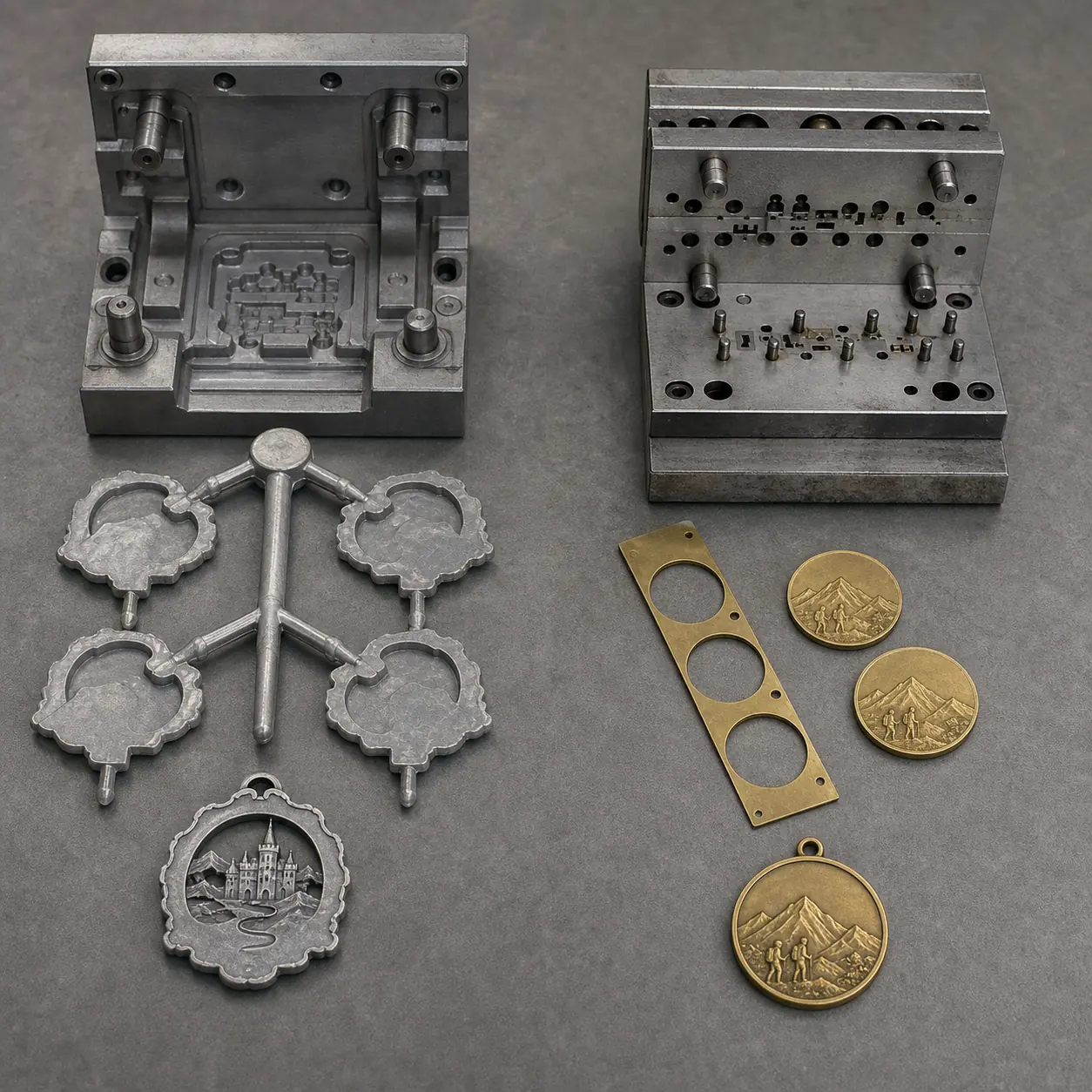
Typical die-cast medal sequence
- Artwork and model: the outline, relief, openings, attachment and parting direction are reviewed.
- Tooling: cavities, runners, gates, vents and ejection features are prepared for the selected machine and alloy.
- Casting: molten zinc alloy enters the closed die and solidifies under controlled conditions.
- Trimming and cleaning: runners, gates and flash are removed before surface preparation.
- Finishing: polishing, plating, antiquing, enamel, assembly, ribbon and packing follow the approved sample.
Typical die-struck medal sequence
- Blank preparation: brass or iron stock is cut or blanked to the required outline.
- Striking: tooling presses the design into the blank; design depth and material behavior influence the number of operations.
- Piercing or trimming: openings and edge features are produced where the design and tooling permit.
- Edge and surface work: burr control, polishing and cleaning prepare the part for finishing.
- Finishing: plating, antiquing, enamel, attachment, ribbon and packing complete the medal.
These sequences are simplified. A real order may combine blanking, striking, trimming, drilling, soldering, polishing, plating and hand assembly in a different order.
Choose around the artwork geometry
Process selection becomes easier when the supplier sees a finished-size drawing rather than only a large concept image. Review the maximum outline, smallest gaps, relief depth, enamel walls, edge distance and attachment as one construction.
Complex silhouette
Multiple projections, internal openings and an integrated loop often point toward zinc alloy die casting.
Clean solid blank
Round, oval or controlled custom outlines with crisp relief may suit brass or iron die striking.
Sculpted subject
Animals, people and landmarks need a relief review; casting is common, but suitable striking can also create volume.
Text and enamel
Legibility and practical metal walls matter more than the process label. Keep wording and color zones controlled.
A die-cast medal can be round and mostly 2D. A die-struck medal can use a custom blank and substantial relief. The question is which route reaches the approved appearance with reasonable tooling, operations and risk.
Relief, side profile and edge behavior
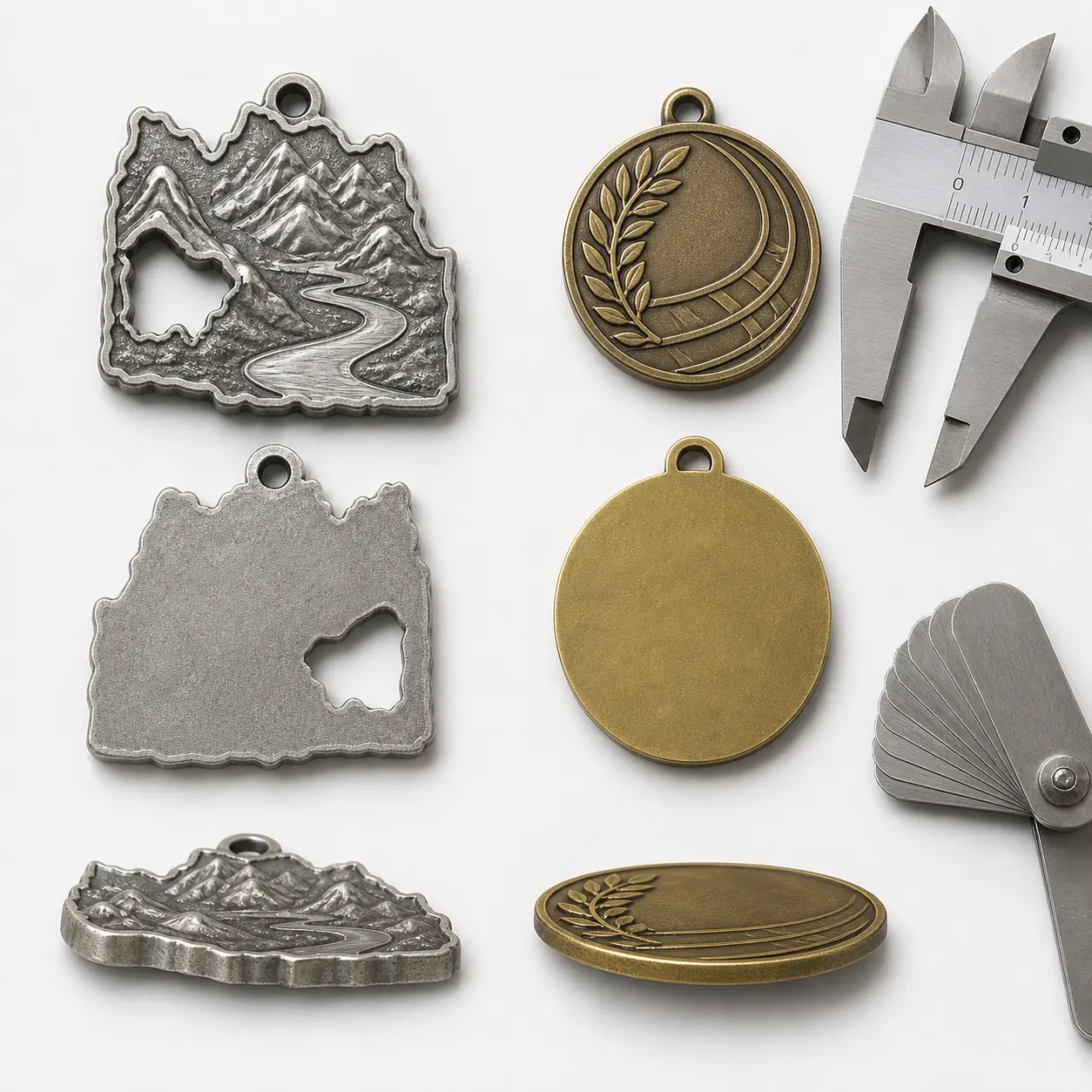
- Base thickness: a struck medal begins with stock thickness, while a cast body is defined by the tool cavity. Both still require an approved side profile.
- Relief height: large images exaggerate depth. Approve a measured model or section view rather than judging shadows alone.
- Parting and gate location: cast medals need practical locations that can be trimmed and finished without damaging visible artwork.
- Blanked and pierced edges: struck parts may need burr control, edge finishing and adequate spacing around openings.
- Attachment: an integrated cast loop, pierced tab, separate loop, ring or ribbon bar must be sized for handling load and presentation.
Use the 2D vs 3D custom medal guide to separate relief style from forming process. A hybrid design may keep lettering in clean 2D levels and reserve sculpted volume for one focal subject.
Material and process are connected—but not interchangeable
Zinc alloy is widely associated with die-cast medals because it flows into complex cavities and supports flexible geometry. Brass and iron are widely associated with die-struck medals because solid blanks respond to stamping, embossing and related press operations. However, the material choice also changes density, hand feel, corrosion protection, polishing behavior, magnetic response and raw-material cost.
| Buyer priority | Practical starting direction | Confirm with supplier |
|---|---|---|
| Large irregular medal with cut-outs | Zinc alloy die cast | Gate, parting line, strength and finishing access |
| Traditional solid brass award | Brass die struck | Blank thickness, strikes, relief and polishing |
| Cost-controlled flat magnetic blank | Iron die struck | Rust protection, plating and magnet requirement |
| Deep sculpted central subject | Compare cast and suitable struck options | Measured relief, tooling and sample result |
| Premium weight in a compact diameter | Compare brass and thicker zinc constructions | Finished unit weight, not material name alone |
For a deeper sourcing comparison, read zinc alloy vs brass vs iron for custom medals.
Plating and enamel do not belong to only one process
Both cast and struck medals can use bright, satin or antique plating directions, subject to the selected alloy and factory process. Both can also carry enamel when the artwork provides suitable recessed areas and separating metal lines.
- Bright finish: exposes surface preparation, flatness and polishing consistency.
- Antique finish: adds contrast in recessed details but should not hide weak artwork.
- Selective enamel: needs practical walls, openings and fill areas at the final size.
- Dual or special plating: may add masking, handling and approval complexity regardless of the base process.
- Protective coating: should be specified when material, route, storage or intended use requires it.
Approve the finished sample under normal light. A raw casting or first strike demonstrates form, but it does not predict the complete plated and colored appearance by itself.
Which process costs less?
There is no reliable answer without a controlled specification. Tooling is only one line. The quotation can also include blanking or trimming, number of cavities, striking operations, raw-material yield, polishing, plating, enamel, attachments, rejects, inspection and packing.
- Outline complexity: a difficult blanking path or multiple cut-outs can change the struck option; a complex cast shape changes tool, flow and trimming requirements.
- Relief: deep or detailed modeling affects tool preparation and process control in both routes.
- Dimensions and weight: diameter, maximum width, body thickness and relief volume influence material and cycle economics.
- Quantity: setup and tooling are distributed across the order, but MOQ is a supplier-and-project decision rather than a universal process rule.
- Finish and color: polishing area, masking, enamel fills and special plating may outweigh the difference in body-forming cost.
- Reorders: confirm tooling ownership, storage period, identification and what artwork changes require new tools.
Give each supplier the same artwork, size, thickness, material direction, relief, finish, ribbon, packaging and quantity. If one process requires an artwork change, record that difference beside the price.
What to approve before production
- Process and alloy: die cast zinc alloy, die struck brass, die struck iron or another approved construction.
- Finished dimensions: maximum width, height, base thickness and maximum relief.
- Front and reverse: exact artwork, spelling, texture and any blank or engraved zones.
- Tooling details: cavity or die scope, openings, outline, attachment and revision limits.
- Finish and color: plating direction, antique contrast, enamel references and protective coating.
- Assembly: loop, ring, clip, ribbon width and packaging fit.
- Physical sample: size, weight, edge, relief, finish, color, attachment and packed presentation.
Include these decisions in the custom medal order checklist so the quotation and sample approval refer to one controlled version.
Fast process-selection guide
| If your design mainly needs… | Start by evaluating… |
|---|---|
| Complex outer shape and several open areas | Zinc alloy die casting |
| Large medal with integrated structural features | Zinc alloy die casting |
| Traditional round brass medal with crisp relief | Brass die striking |
| Simple cost-focused iron award blank | Iron die striking |
| Deep portrait, animal or landmark relief | Side-by-side tooling and sample review |
| Unusual finish, spinner or multi-part feature | Complete construction review, not body process alone |
If the design could suit either process, ask for two annotated proposals. The useful answer is not just “cast” or “struck”; it is what changes in material, thickness, relief, tooling, appearance, cost and lead time.
Frequently asked questions
What is the main difference between die cast and die struck medals?
Die casting forms the body by introducing molten alloy into a shaped die cavity. Die striking presses a design into a solid metal blank. Either can make a high-quality medal when matched to suitable artwork and controlled production.
Is die casting better for 3D custom medals?
Zinc alloy die casting is often practical for complex outlines, open areas and sculpted relief. Die struck medals can also use substantial relief with suitable material, tooling and press operations. Review the actual model and sample.
Are die struck medals more expensive?
Not necessarily. Cost depends on dimensions, thickness, material, tooling, relief, blanking, finish, color, accessories and quantity. Compare equivalent finished specifications.
Can both processes use enamel color?
Yes, when the approved design provides practical recessed areas and separating metal boundaries. Confirm color method, minimum line widths and surface finishing for the chosen construction.
Can the same design be quoted in both processes?
Often yes, but each version may need adjusted relief, outline, thickness, attachment or material. Ask the supplier to show the design changes beside each quote.
How can I identify an existing cast or struck medal?
Runner or gate traces, a parting line, outline complexity and base-thickness behavior can provide clues, while a sheet-derived edge and compressed relief may suggest striking. Finishing can hide these signs, so production records are more reliable.