
Custom medal relief guide
2D vs 3D custom medals: which relief should you choose?
Choose the relief structure that translates the artwork clearly at the finished size. 2D and 3D are production directions—not simple quality levels.

Choose 2D relief when the medal depends on crisp logos, readable text, borders, icons or separated enamel colors. Choose 3D relief when the subject needs rounded form—such as a face, animal, mascot, building, vehicle or landscape. Many successful medals combine both: a 3D central subject with 2D wording and borders.
What “2D” and “3D” mean in medal production
Every physical medal has thickness. In this context, 2D and 3D describe how the artwork is modeled into the medal face rather than whether the object itself is flat.
- 2D relief: artwork is divided into clear raised and recessed levels. Surfaces within each level remain relatively flat, so edges and color boundaries are easy to define.
- 3D relief: height changes gradually across curved surfaces. The model uses rounded contours, slopes and transitions to communicate volume.
- Hybrid relief: selected sculpted areas are combined with flat levels for text, borders, enamel or geometric details.
A more dimensional medal is not automatically more premium. If 3D modeling makes a logo less accurate or small text harder to read, a controlled 2D construction is the better specification.
2D and 3D medal relief at a glance
| Decision | 2D relief | 3D relief |
|---|---|---|
| Surface structure | Distinct flat raised and recessed levels | Gradual curves and sculpted height transitions |
| Strong subjects | Logos, lettering, borders, icons and geometric art | Portraits, animals, figures, architecture and landscapes |
| Color planning | Clear metal walls can separate enamel areas | Often strongest as metal-led relief or with selective color |
| Artwork review | Check level assignments, line width and color boundaries | Check contour, depth, silhouette, highest points and viewing angle |
| Visual character | Graphic, clean and readable | Sculptural, tactile and shadow-rich |
| Common risk | Too many thin lines or tiny recessed areas | Excess detail that becomes soft or crowded at final size |
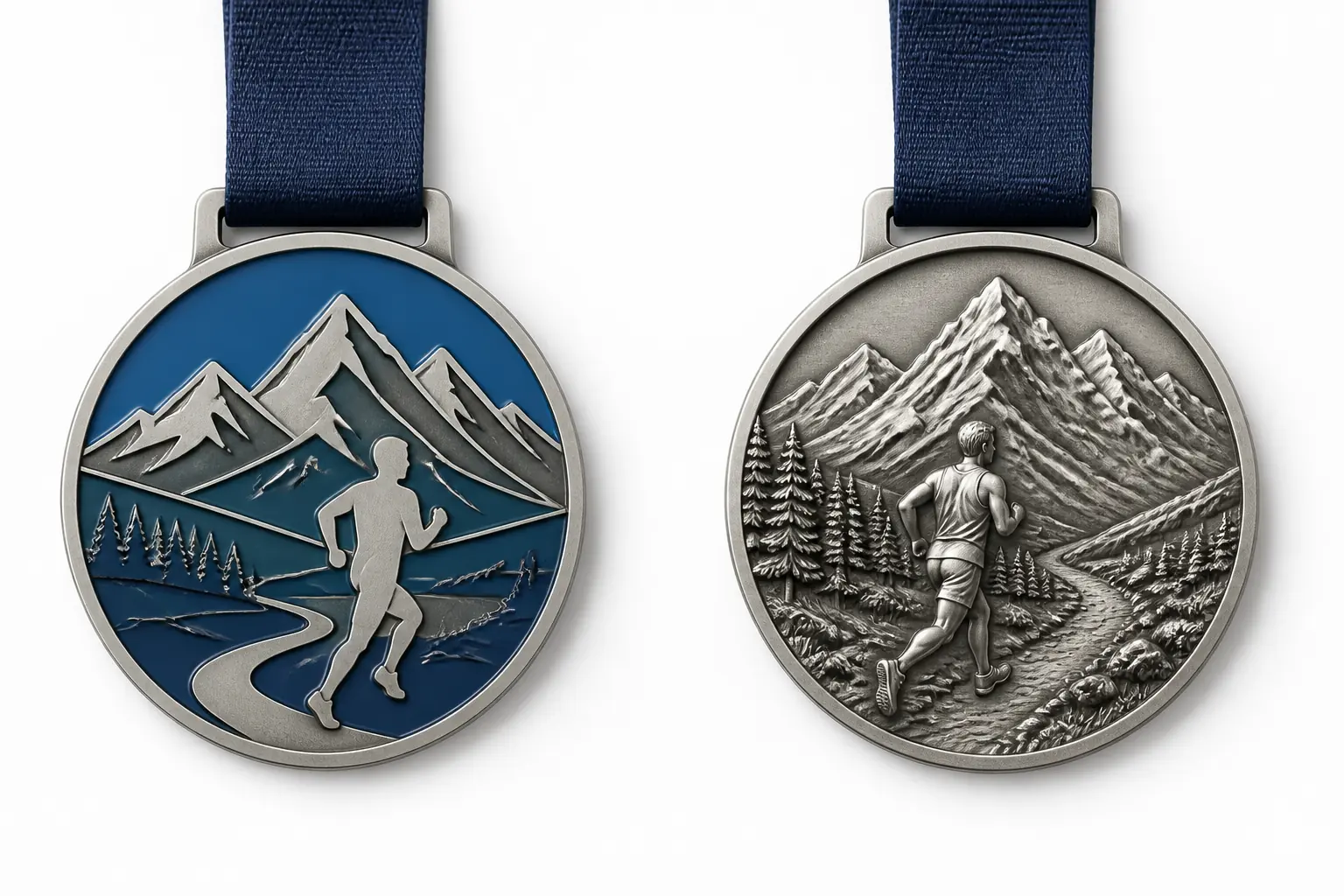
The comparison begins with artwork, but size, thickness, base material, forming method and finish also affect how clearly the chosen relief appears.
When 2D relief is the stronger choice
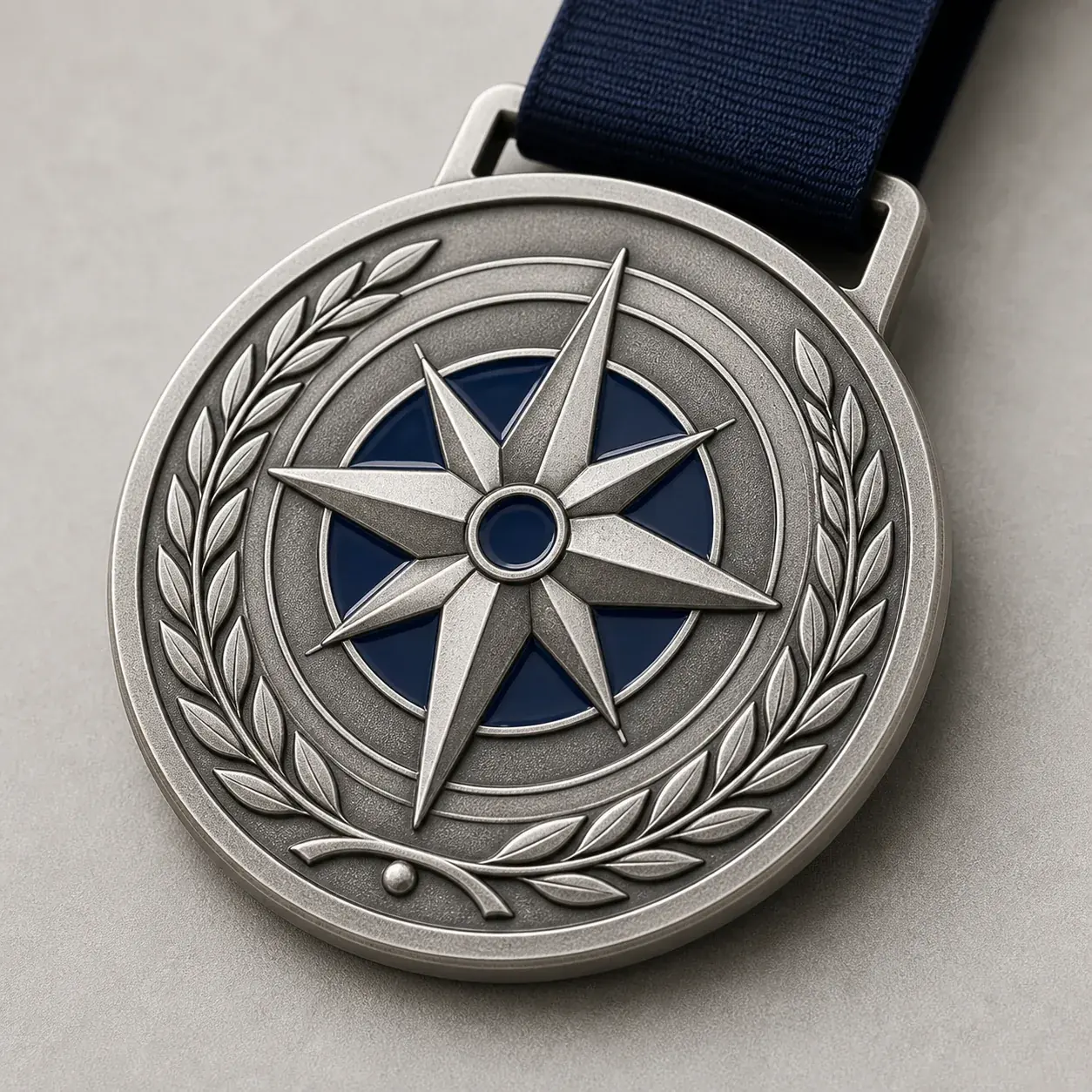
2D relief gives designers predictable boundaries. That makes it practical for event identity, sponsor requirements and award systems that need consistent reproduction across several finishes or years.
Logos and seals
Flat brand marks, school crests and club emblems usually benefit from controlled edges and proportions.
Text-heavy layouts
Event names, dates, categories and sponsor wording remain easier to separate from the background.
Enamel color blocks
Raised metal walls can define practical compartments for selected color-filling processes.
Award-level systems
One controlled design can be repeated in gold-, silver- and bronze-tone finishes or different ribbon colors.
2D does not mean visually plain. Texture, polished highlights, recessed patterns, cut-outs, antique contrast and selective enamel can create depth while preserving graphic clarity.
When 3D relief earns its place
Use 3D relief when the design story depends on form rather than only outline. A portrait needs cheeks, brow and facial planes; an animal needs body volume; a landmark may need columns, roofs and perspective. Those shapes are difficult to communicate through a few flat levels alone.
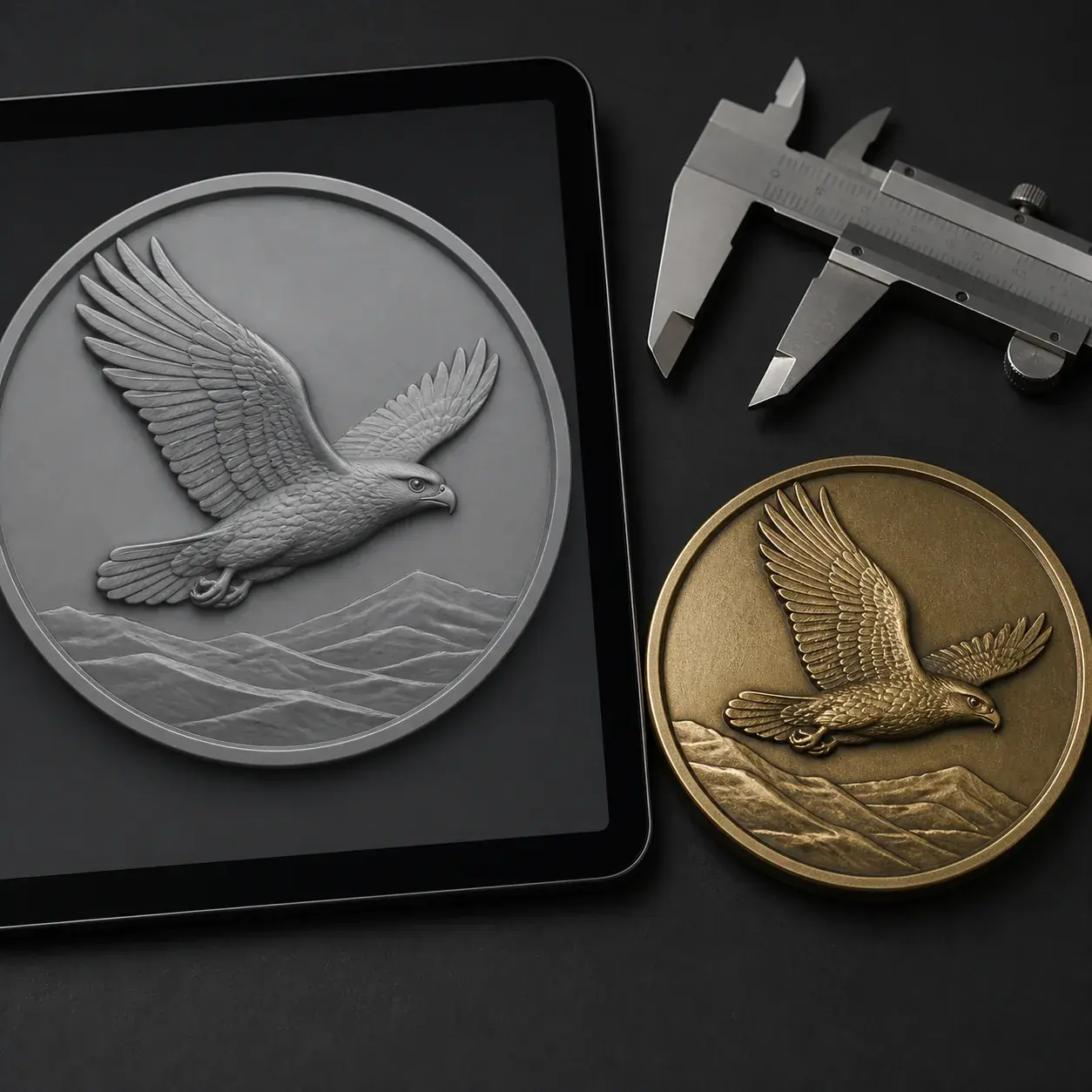
- Portraits and people: gradual facial and body contours can create a more natural interpretation.
- Animals and mascots: feathers, fur, muscle and posture benefit from controlled sculpting.
- Buildings and landscapes: foreground, middle distance and background can be separated through depth.
- Commemorative pieces: metal-led relief can support a traditional, collectible presentation.
More detail is not always more successful. The design still has to survive reduction to the approved medal size, polishing, plating and normal viewing distance. Strong large forms often read better than hundreds of shallow micro-details.
A hybrid design often solves the real problem
Buyers do not always need to choose one method for the whole face. A medal can use a sculpted central figure while keeping the outer ring, event name, date and sponsor marks as 2D relief. This protects readability without giving up the dimensional focal point.
| Design element | Practical relief direction | Reason |
|---|---|---|
| Main portrait or mascot | 3D | Rounded volume supports expression and recognizable form. |
| Event name and date | 2D | Controlled height and edges support legibility. |
| Sponsor logos | 2D or print | Brand geometry should not be unintentionally reshaped. |
| Background texture | Shallow 2D or low relief | Keeps the background from competing with the focal subject. |
| Outer border | 2D | Creates a stable frame and protects the composition. |
Ask the supplier to mark the 2D and 3D zones on the production artwork. A verbal request such as “make the center more 3D” is too open to interpretation.
How enamel and finish change the decision
Relief, plating and color must be planned together. Bright polished metal emphasizes clean edges. Antique treatments darken recesses and can make sculpted relief easier to read. Enamel adds strong color but needs suitable boundaries and enough area for consistent filling.
- Color-led artwork: start with 2D metal boundaries when large, accurate color zones define the identity.
- Metal-led artwork: consider 3D relief with antique or satin contrast when shape and shadow carry the design.
- Selective color: use enamel to support a 3D focal area without covering the contour that should remain visible.
- Fine gradients or photos: discuss printing rather than forcing complex tonal artwork into relief or enamel.
Review the custom metal finish guide before approving bright, satin, antique or dual-finish directions.
Size, thickness and material set the available depth
A relief style cannot be evaluated separately from the medal body. A small, thin medal gives the model less physical space to create obvious height changes. A larger or thicker construction may show sculpted transitions more clearly, but it also changes weight, ribbon balance, packing and freight.
- Finished size: review the design at actual production dimensions, not only enlarged on a monitor.
- Thickness: confirm the base thickness and maximum relief height rather than one vague thickness number.
- Material and process: die-cast zinc alloy is often considered for complex sculpted forms, while suitable stamped constructions can produce crisp 2D relief and selected dimensional effects.
- Attachment: verify that the ribbon loop or slot fits the medal weight and orientation.
Use the medal size guide and medal material comparison to complete these decisions.
What to approve before tooling and sampling
A polished rendering can communicate the concept, but approval should focus on manufacturable information. The more sculpted the design, the more important it is to review depth before the finish distracts from the underlying form.
Front view
Check hierarchy, proportions, spelling, borders and the relationship between all design zones.
Relief view
Review highest and lowest points, slopes, undercuts, thin bridges and areas that may polish differently.
Side profile
Confirm body thickness, maximum relief, rim protection and attachment construction.
Physical sample
Inspect readability, shadows, finish, enamel, weight, ribbon and packing under normal light.
A single front photograph leaves the side contour open to interpretation. When possible, provide front, three-quarter and side views or a clear sculpting brief.
Does 3D relief change cost or lead time?
It can. Detailed sculpting may require additional model preparation, internal review and buyer revisions before tooling. However, relief style is only one quotation factor. Diameter, thickness, base material, number of sides, finish, enamel, ribbon, packaging and quantity all influence the complete order.
Request comparable quotations using the same specification. If a supplier quotes both a 2D and 3D direction, ask what changes in modeling, tooling, sample timing and the finished appearance. See the custom medal cost guide and production timeline for the wider planning picture.
Choose by what must remain clear
| Project priority | Starting direction | Buyer check |
|---|---|---|
| School crest and award wording | 2D | Test the smallest text at finished size. |
| Race medal with landmark | Hybrid or 3D | Keep date and sponsor marks in controlled zones. |
| Corporate logo recognition medal | 2D | Protect logo proportions and approved brand colors. |
| Animal mascot or portrait | 3D | Provide multiple visual references and approve contour. |
| Colorful event illustration | 2D enamel or print | Confirm practical color boundaries and line widths. |
| Traditional commemorative medal | 3D or hybrid | Review antique contrast and side profile. |
If the artwork contains several priorities, rank them. A medal cannot maximize tiny text, deep sculpture, many enamel colors, a very thin body and a low unit target simultaneously without trade-offs.
Relief quotation checklist
- Artwork: editable logo files, sketch or clear concept references.
- Relief direction: 2D, 3D or a marked hybrid layout.
- Dimensions: finished width or diameter, body thickness and target weight if relevant.
- Design priorities: identify text, logos, portraits, landmarks and details that cannot change.
- Color and finish: enamel or print zones plus bright, satin or antique treatment.
- Quantity and variants: total pieces, award levels and likely repeat orders.
- Assembly: ribbon width, attachment, packaging and presentation requirements.
- Schedule: required delivery date, destination and sample-approval contact.
Add these details to the custom medal order checklist before comparing supplier quotations.
Frequently asked questions
What is the main difference between 2D and 3D custom medals?
2D relief uses distinct raised and recessed levels with relatively flat surfaces. 3D relief uses gradual curves and sculpted transitions to represent volume.
Are 3D medals always better than 2D medals?
No. 2D is often clearer for logos, text, borders and enamel areas. 3D is useful when portraits, animals, landmarks or organic forms need rounded volume.
Can one medal combine 2D and 3D relief?
Yes. Keep wording and borders in controlled 2D levels while using 3D modeling for one central subject. Mark each zone clearly on the production artwork.
Can enamel be used on a 3D medal?
Yes, when the color areas and relief are designed together. Selective enamel often works better than covering contours that need visible highlights and shadows.
Do 3D custom medals cost more?
They can require additional modeling and tooling review, but total cost also depends on dimensions, material, quantity, finish, color, ribbon and packaging.
Do I need to supply a 3D model?
Not always. Clear front and side references may be enough for a supplier to prepare the model. Confirm who creates it, which revisions are included and what must be approved.