
Soft Enamel vs Hard Enamel Pins: Which Should You Order?
Your logo is ready, but the quotation asks you to choose soft or hard enamel. The names do not tell you how the finished pin will look on a uniform, retail card or event lanyard. Start with the surface you want people to see and feel, then check whether the proposed artwork and finish support it.
The main difference: soft enamel typically leaves color below raised metal borders. Hard enamel has a face polished so the color and metal sit substantially flush. Choose soft enamel for a clearly outlined, textured appearance; consider hard enamel when a smooth, continuous face is central to your design. Neither name alone establishes the quality of the finished order.
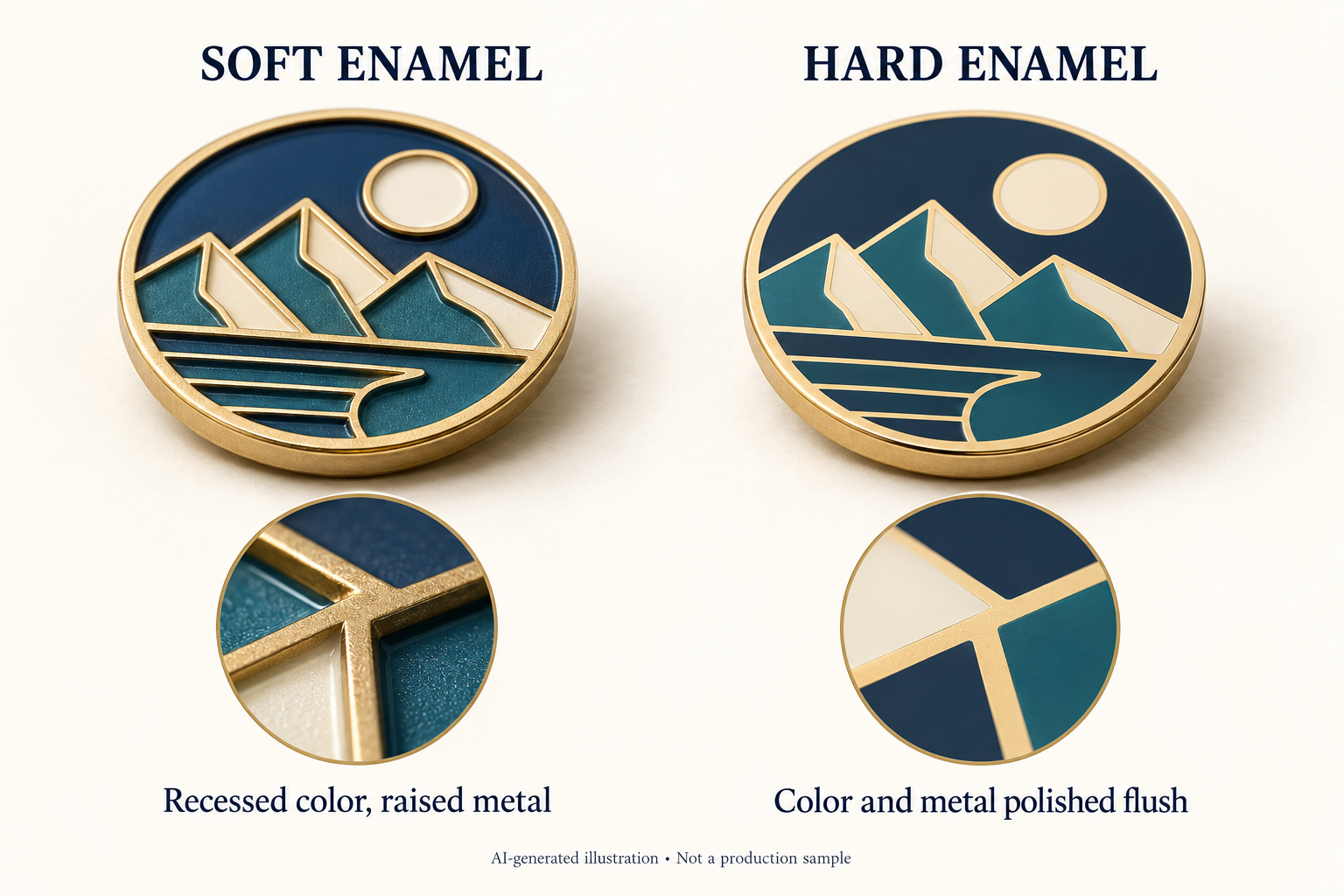
What do “soft” and “hard” actually describe?
For the buyer, the useful distinction is the relationship between the color fill and the metal lines. A soft-enamel construction retains visible relief between them. A hard-enamel construction is finished toward a level face. A front-on photograph can conceal that difference, so request an angled view or a physical sample.
The names do not mean that a soft-enamel metal pin bends like rubber, or that every hard-enamel pin uses the same filling material. Ask the supplier to identify the quoted construction when its terminology is unclear. Supplier explanations of the basic surface distinction can be found in CreatePins’ comparison and Signature Pins’ process description.
Compare the result your buyer will receive
| Decision | Soft enamel | Hard enamel |
|---|---|---|
| Surface appearance | Metal outlines stand above the color fields. | Metal and color form a substantially level, polished face. |
| Design intention | Consider when the metal borders should add visible depth. | Consider when a smooth graphic surface is important. |
| Artwork approval | Review the shape and readability of the raised divisions. | Review how fine divisions and small lettering will appear after finishing. |
| Finish selection | Confirm the exact metal finish and any optional coating. | Confirm that the requested finish is compatible with the proposed construction. |
| Buying decision | Compare the finished sample, attachment and packaging. | Use the same acceptance points, including the agreed surface appearance. |
Which one fits your logo?
Look at your design at the actual pin size. Are the outlines part of its identity? Does the logo depend on small lettering, closely spaced lines or several narrow color areas? Ask for a production interpretation that marks any changes before deciding between processes.
Do not assume a large rendering proves that tiny lettering will remain readable. If the factory recommends thicker lines, fewer details or a larger pin, review the revised version with the brand owner. There is no single line-width limit that applies to every supplier, size and construction.
If your artwork relies on gradients or photographic detail, first consider whether printing is more suitable. Our enamel vs printed pin guide addresses that separate decision.
A smooth coating does not make a pin hard enamel
A clear epoxy layer can give a soft-enamel pin a smooth outer surface while the recessed construction remains underneath. That is a different specification from a polished hard-enamel face. Signature Pins describes epoxy as an optional treatment for soft enamel; availability and terms must be confirmed with your own supplier.
Ask whether the quoted pin includes a clear coating, whether it is flat or domed, and how it changes the appearance of the metal borders. Avoid approving a sample simply because it looks glossy.
Is hard enamel worth the extra cost?
Request both options against the same design, size, quantity, metal finish, backing and packaging. If the hard-enamel option costs more, identify what that difference buys in the proposed finished product. A different pin size or attachment can make the comparison misleading.
For a retail range, judge the sample alongside its backing card and intended presentation. For a uniform pin, review legibility, attachment and comfort as well as the face. For an event giveaway, decide which visible features matter enough to retain within the budget. Either construction can be appropriate; the sample should justify the selection.
Do not assign a universal percentage premium or assume one option always arrives sooner. Use the project quotation for cost and timing.
How to approve the sample before a bulk order
- Confirm the construction in writing. Record soft or hard enamel, the metal finish and any clear coating.
- View the face at an angle. Compare the surface profile with the appearance you selected.
- Read the logo at finished size. Inspect small text, enclosed spaces and metal divisions against the approved artwork.
- Review color under consistent lighting. Compare against your agreed reference rather than a phone screen alone.
- Check the complete pin. Include the reverse, posts, clutch and packaging. Surface choice does not determine whether an attachment meets your needs.
- Record the approved version. Keep photographs and the agreed sample reference, with any remaining changes clearly listed before production.
If wear resistance is important, tell the supplier how the pin will be used and agree on a suitable evaluation. The word “hard” is not a substitute for a defined performance requirement.
Questions buyers often ask
Does soft enamel mean low quality?
No. Recessed color is a design characteristic. Judge quality by the agreed artwork, workmanship, attachment and accepted sample, rather than the process label.
Can I use the same artwork for both options?
It can be a starting point, but ask the supplier to confirm whether each option needs changes. Approve those changes separately so the comparison remains clear.
Can a photograph prove which process was used?
It may show the surface profile, but lighting and clear coatings can obscure it. Confirm the written specification and request a sample when the distinction matters to the order.
Choose the surface around your design
Planning custom enamel pins? Send your logo and tell us which surface you prefer: raised metal with recessed color, or a polished flush face. If you are undecided, ask us to review both routes and identify the differences before you approve artwork.
For the remaining order details, use our bulk pin purchasing guide.
Sources and image note
The linked supplier pages describe their own products and processes; their prices, lead times and service terms are not Extra Dream commitments. The comparison image was generated for this article and illustrates a surface concept. It is not factory photography or evidence of sample quality.