
Brand merchandise / Corporate buying guide
Custom Metal Promotional Products: Turn Your Logo into Pins, Keychains, Coins & More
A useful metal keepsake does more than repeat a logo. It gives employees, customers and partners a small, tangible reason to remember the brand.
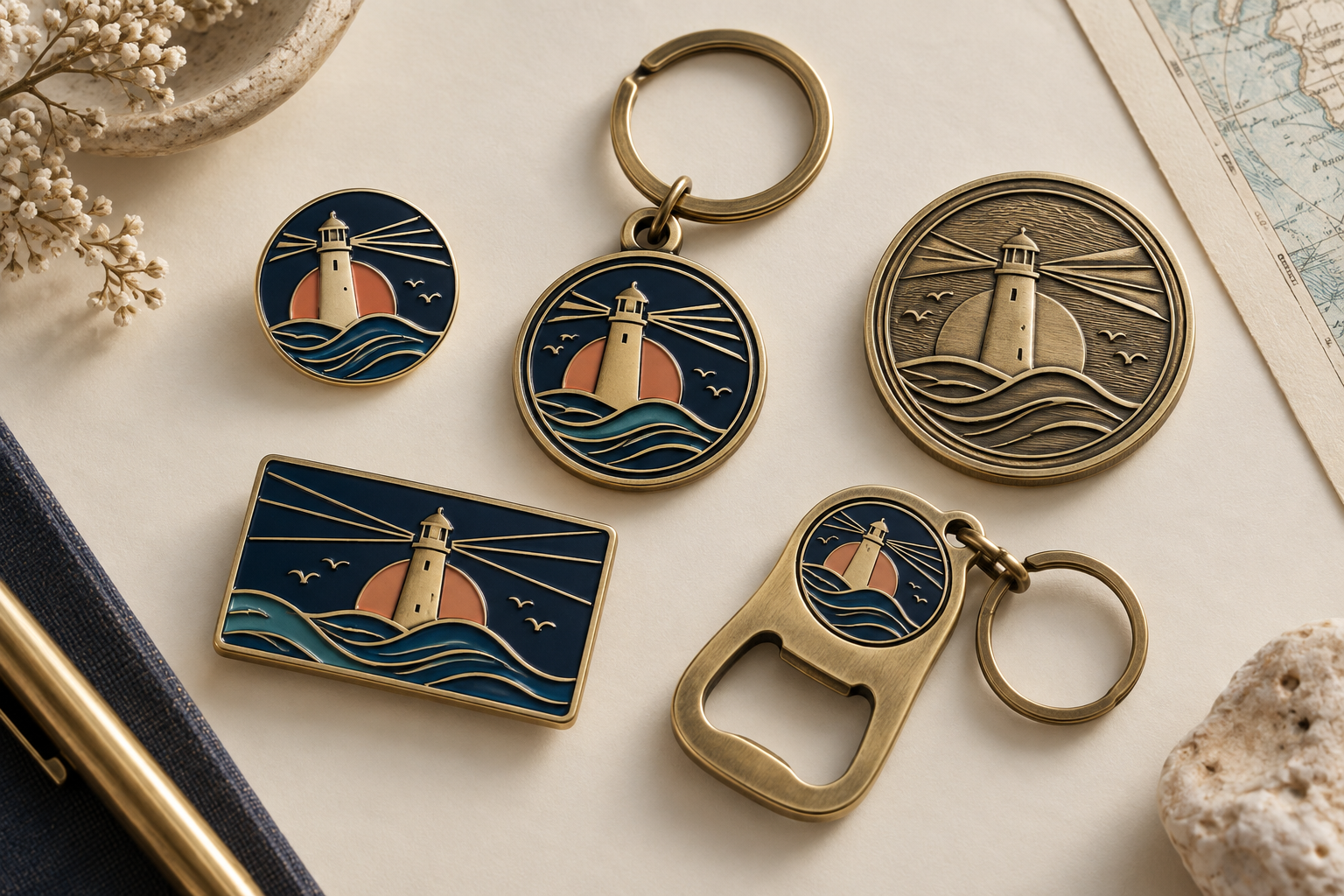
A planning meeting is almost over when someone points to the logo on the screen and says, “Let’s turn it into merchandise.” The sentence sounds simple. For the buyer, it immediately creates a longer list: Should it be a lapel pin, keychain or commemorative coin? Is it for employees, customers or business partners? Does the full logo need to appear? How do you keep it from feeling like a cheap giveaway?
The value of custom metal promotional products comes from translating the most memorable part of a brand into something people will wear, use, display or receive with a sense of occasion. That starts before a factory prepares the production artwork.
01 / Find the memory
Start with the brand symbol people already recognize
A logo is part of an identity system, but the complete logo is not always the best subject for a small metal object. A coffee shop may be known for its arched storefront window. A technology company may have the silhouette of its first product. A school may have a clock tower, motto or mascot. Such elements often survive at pin size better than a long company name.
Sort the available material into three layers:
- Recognition: the logo silhouette, primary colors, type style or a consistent frame.
- Story: a mascot, building, signature product, local landmark or shared experience.
- Occasion: an anniversary year, project name, event date or one short phrase.
These layers do not all need to compete on the front. Let the front create instant recognition, then use the reverse, backing card or presentation box to carry the story. One clear subject is usually stronger than five tiny elements fighting for attention.
02 / Choose the action
Ask what the recipient should do with it
Do not begin with “What is popular?” Begin with four verbs: wear, use, display and collect. The intended action points toward the right format and gives procurement a better way to compare ideas.
| Desired action | Products to consider | Strong use cases |
|---|---|---|
| Wear | Enamel pins, lapel pins | Employee identity, membership, event participation |
| Use | Metal keychains, bottle openers, bookmarks | Customer gifts, hospitality, regular brand contact |
| Display | Fridge magnets, small desk pieces | Retail stores, destinations, museums and exhibitions |
| Collect or present | Challenge coins, commemorative coins, pin sets | Company anniversaries, project completion, recognition and partnerships |
Trade-show items should be easy to carry and realistic at volume. An employee anniversary gift must explain “why this year” and “why me.” A partner gift also needs suitable presentation and should fit the recipient’s gift policy.
No product is automatically more prestigious. A well-chosen keychain may stay in daily use longer than a heavy coin that arrives without a story or presentation moment.

03 / Build a family
The same symbol does not have to look identical on every object
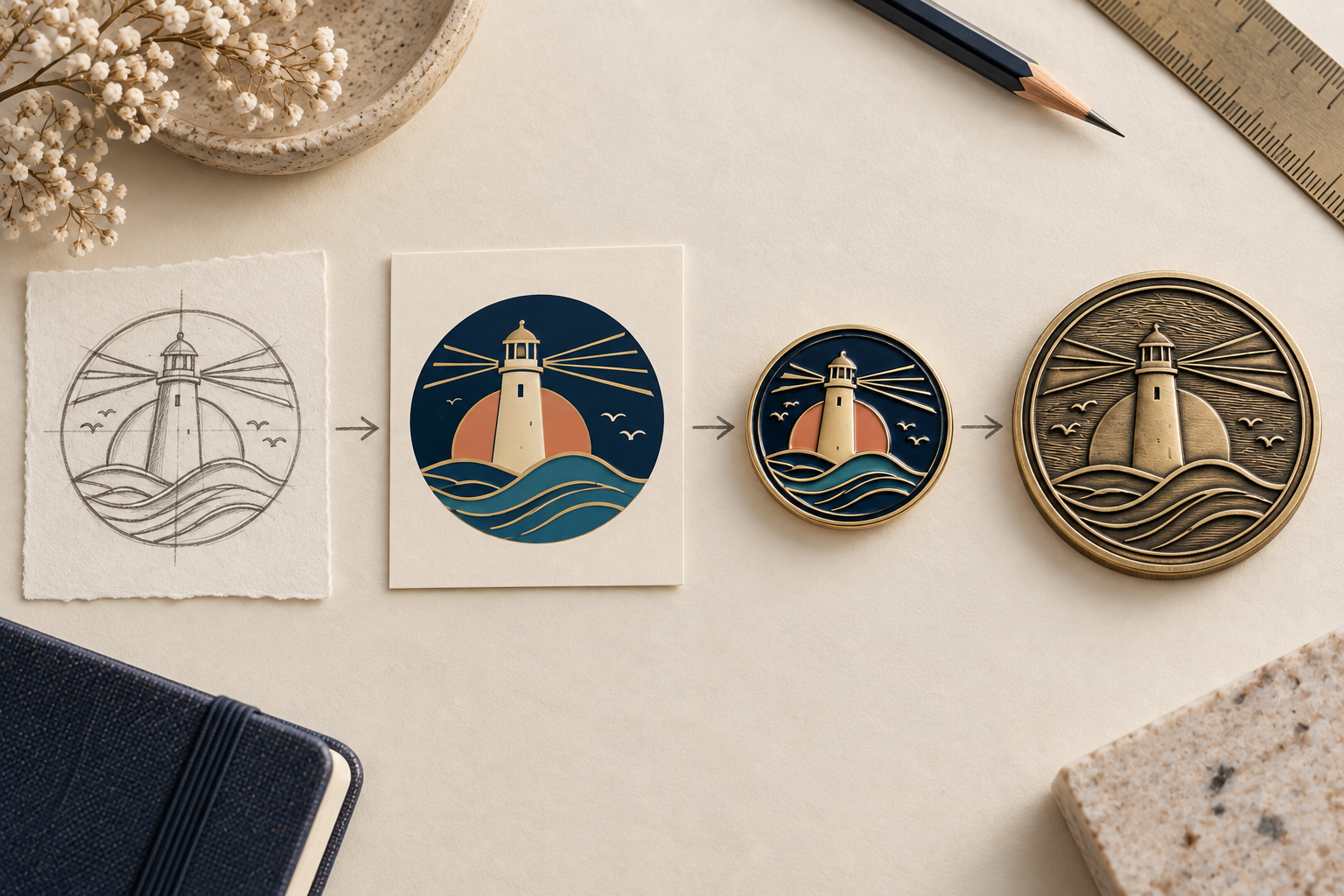
A merchandise collection should feel related, but consistency does not require mechanical duplication. A building can become a clean outline with two or three enamel colors on a pin. The coin version can use relief and shadow. A keychain can follow the building’s outer shape, while a magnet may add a location name or series marker.
Keep the visual grammar consistent: the main silhouette, metal tone, border proportion, core colors or series device. Let the process support that language. Enamel works with defined color areas; relief creates volume and light; cutouts use recognizable negative space; laser engraving can carry numbering or secondary information on the reverse.
Final feasibility depends on size, material, tooling and construction. Ask the supplier to mark every simplification, recessed area, cutout and engraved detail on the production proof.
04 / Align the team
Give brand, marketing, HR, procurement and the supplier one brief
Corporate orders often go wrong because different people approve different versions of the idea. Brand protects colors and logo rules. Marketing looks for visibility. HR knows the recipient. Procurement controls quantity, price and schedule. The supplier needs measurable instructions for size, process, packaging and approval.
Who receives the item, and at what occasion?
What is the quantity for each design, not only the total?
Which brand elements are mandatory, and which may be adapted?
What size, attachment and method of use are expected?
Are cards, boxes, labels, individual bags or assembly included?
Who approves the sample, and what is the final delivery date?
Compare complete scopes when reviewing quotations. A price for loose, unpacked pieces is not equivalent to a price that includes tooling, a sample, card mounting, individual packing and transport.
05 / Protect the result
Five decisions that make branded metal merchandise easier to discard
- Making the logo too large.
A recipient may keep a beautiful symbol but hesitate to wear a portable billboard.
- Putting the company introduction on the front.
A small metal surface cannot carry brochure-level detail. Move supporting copy to the reverse or packaging.
- Approving only an enlarged screen rendering.
Digital proofs can zoom forever; the product cannot. Print a true-size outline and inspect a complete physical sample.
- Ignoring the back.
Clutches, magnets, numbering, relief and branding all affect wearing, handling and packing.
- Leaving packaging until the end.
The first presentation is part of the brand experience. Plan the card, box and message with the product.
A usable request for quotation
“We are planning a collection of custom metal products for our company’s tenth anniversary, primarily for employees and business partners. The attachment includes our logo, brand colors and building outline. Please recommend one wearable option and one formal presentation option. State the proposed size, material, process, minimum quantity per design, tooling, sample, packaging and shipping. Mark any artwork details that need simplification and provide one fully packed sample for approval.”
This does not make every decision for the buyer. It tells the supplier that the project has an audience, an occasion and a brand standard. It also creates a common basis for comparing proposals.
Create something worth keeping
Let one memorable symbol carry the story forward.
A successful metal keepsake does not need to explain the company’s entire history in seconds. It needs to make one meaningful idea tangible when someone picks it up, wears it or adds it to a collection.